
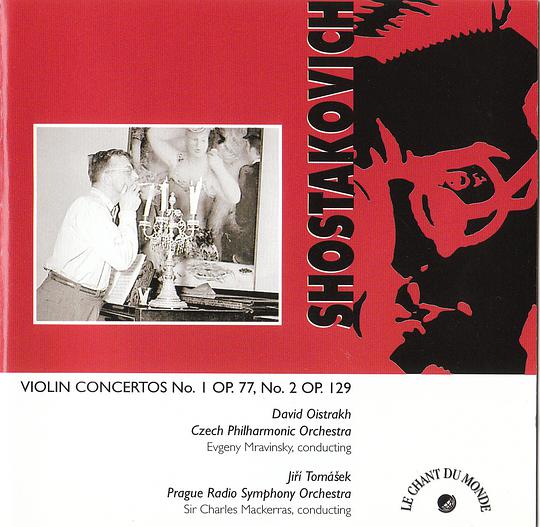
听过《Violin Concertos No.1 0P.77,No.2 OP.129》 🌕🌕🌕🌕🌕
第一小协是1957年Mravinsky+Oistrakh与布拉格广播的现场,第二小协是1982年Mackerras+Tomášek与捷克爱乐;穆皇和奥胖这个布拉格现场应该和,与普6收在一起的那张里的那个是同一个版本(没找到那张的音源(
Music
Violin Concertos No.1 0P.77,No.2 OP.129
Douban
Shostakovich
release date 2000-01-01
publisher:
Praga Productions
shostakovitch violin concerto#1
"The concerto lasts around 35 minutes and has four movements, with a cadenza linking the final two:
1. Nocturne: Moderato - A semi-homage to the first movement of Elgar's Cello Concerto.
2. Scherzo: Allegro - Demonic dance.
3. Passacaglia: Andante - Cadenza (attaca) - Utilizes Beethoven's fate motif, incorporating it into the pre-burlesque cadenza.
4. Burlesque: Allegro con brio - Presto - The theme in the solo violin's entrance resembles that was the solo flute's entrance in Stravinsky's Petrouchka.
The work is scored for piccolo, three flutes, three oboes, cor anglais, three clarinets (3rd doubling bass clarinet), two bassoons, contrabassoon, four horns, tuba, timpani, tambourine, tam-tam, xylophone, celesta, two harps and strings.
Oistrakh characterised the first movement as "a suppression of feelings", and the second as "demoniac". The scherzo is also notable for an appearance by the DSCH motif representing the composer himself. Boris Schwarz (Music and Musical Life in Soviet Russia, 1972), commented on the passacaglia's "lapidary grandeur" and the burlesque's "devil-may-care member stoking abandonment". The beginning of the passacaglia is also notable for its juxtaposition of the invasion or Stalin's theme from the Seventh Symphony and the fate motif from Beethoven's Fifth Symphony.
The concerto is sometimes numbered as Opus 99: the time-lag between composition and performance is the reason that it was originally issued as Opus 77 (Opus 77 was then allocated to Three Pieces for orchestra)."