Ornstein: Piano Quintet; String Quartet No. 2
Douban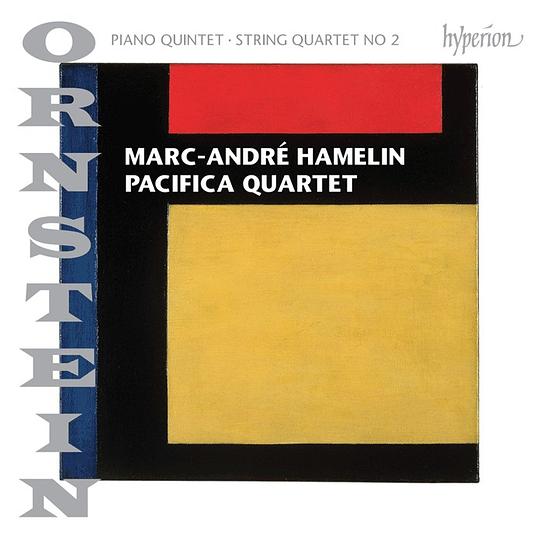
visão geral
The young pianist-composer Leo Ornstein went from wowing the ladies with his virtuosity to writing a Violin Sonata in 1915 of such atonal violence that it frightened even him.
By the time of the two works recorded here his style was more rounded. The mix of enfant terrible and Lisztian piano-slayer is now tempered by an intense lyricism, the rhythmic energy balanced by searing poetry.
In the exhilarating hands of Marc-André Hamelin and the Pacifica Quartet these performances fizz with exuberance. A real treat.
In 1913 Leo Ornstein was on the verge of launching a major career as a concert pianist. Born in the Ukraine, he had been admitted to the St Petersburg Conservatory at the age of ten, but his family had been forced to flee Russia in 1906 because of anti-Semitic pogroms. Arriving in New York he won a scholarship to the newly formed Institute of Musical Art, later to become Juilliard, and was carefully groomed for his place on the concert stage.
Then something snapped. Ornstein began hearing strange dissonant sounds in his head followed by complete pieces. Later he recalled one of his early compositions: ‘Danse sauvage was written by a young person with no experience whatever with modern music. I still wonder at the age of eighty, why should I have thought of that? A boy that had been sitting at the piano practising [Liszt’s] Twelfth Rhapsody to try to astonish the ladies with the speed and accuracy of the passages, and blind the audience with the terrific glissandos and what not. Why suddenly that thing came into my head—I’ll be blessed if I know. And as a matter of fact, I really doubted my sanity at first. I simply said, what is that? It was so completely removed from any experience I had ever.’ Ornstein may not have been as unfamiliar with modern music as he suggested, but his epiphanic experience is borne out by other sources.
More ultra-modern pieces followed and Ornstein became a sensation, the enfant terrible of modern music. He regularly performed to sold-out audiences, who were amused, angered, bewildered, yet often moved by what they heard. Critics raved: Waldo Frank prophesized that, of Stravinsky, Schoenberg and Ornstein, ‘Ornstein, the youngest of these, gives promise to be the greatest’; Charles Buchanan called him ‘the most salient musical phenomenon of our time’; and an anonymous critic for the London Observer dubbed Ornstein ‘the sum of Schoenberg and Scriabin squared’.
Yet by the early 1920s Ornstein’s life and his music had changed dramatically. He abandoned both his concert career and his highly dissonant ultra-modern style. The reasons for the first of these are not clear, and the musical world was shocked by his sudden disappearance. Ornstein himself explained the second development. In 1915 he composed his second violin sonata, his most atonal, dissonant and uncompromising piece, and it frightened him: ‘I would say that Op 31 had brought music just to the very edge … I just simply drew back and said, “beyond that lies complete chaos”.’ More cryptically he observed: ‘After I have lain down on the piano keyboard and sounded all the notes at once—what then?’
Just as other composers were discovering ultramodernism, Ornstein pulled away from its rigours to allow a more expressive voice to surface. In doing so he found his natural métier, for Ornstein was at core a lyricist. His later music remains fully rooted in the harmony and dissonance of the twentieth century, but his melodies have a lyrical, poetic quality that forms a foil to the harmonic complexities surrounding them. This style describes both the String Quartet No 2 and the Piano Quintet.
Both the Piano Quintet and the String Quartet No 2 were written in the late 1920s, after Ornstein had accepted a position as head of the piano department at the Zeckwer-Hahn Philadelphia Music Academy. Even though he no longer regularly performed, he continued to receive commissions. Elizabeth Sprague Coolidge, an important patron in early twentieth-century American musical culture, privately commissioned the Piano Quintet. The first performance, sponsored by the Society for Contemporary Music, occurred in Philadelphia on 1 January 1928, with Ornstein at the piano. The concert also featured two works by Béla Bartók, who was also present and shared the stage with Ornstein. Several other performances occurred in the late 1920s and early 1930s, and except for one in Paris always with Ornstein at the piano.
Ornstein believed in a highly intuitive approach to composition. He claimed that music simply came to him and resounded in his head until he could exorcise it by writing it down. This was not entirely true, as the manuscript for the Piano Quintet contains many small corrections, probably made after rehearsals with the string players. Yet Ornstein’s intuitive approach is key to the work. Its wild, driving, energetic character, with many abrupt changes in tone and mood, presents Ornstein at his most direct and personal. Many musicians and writers consider it his best piece. Years later Ornstein commented: ‘The Quintette [as he called it] is not a polite piece … it may be overcharged but it is what I heard. Possibly it might have been less blunt and emotionally more reserved, but if one does not sense its almost brutal emotional directness, then I have indeed failed.’ He admitted that maintaining its emotional power forced him to sacrifice a greater unity he might otherwise have achieved, but ‘any attempt to modify it destroyed whatever was genuine’.
The first movement begins Allegro barbaro, which may have been a homage to Bartók, whose famous primitivist piece has the same title. The Quintet’s opening fits precisely Ornstein’s own description: it is wild, energetic, rhythmically charged and emotionally intense. This tone soon gives way to a meno mosso section where Ornstein’s lyricism comes to the fore. A modal melody passes through the strings against an undulating piano accompaniment, then builds in intensity as he increases the surface rhythm to usher in another driving agitato feroce. The movement continues to alternate between these two general moods, with much variation and a hint of a recapitulation of the opening material near the end. The movement is not atonal, but the shifting harmonies and an emphasis upon minor seconds and tritones prevent a single overriding key from emerging.
The second movement, Andante lamentoso, is one of Ornstein’s most lyrical statements. It is quiet and introspective, even though there are frequent tempo changes and the mood is broken three times by more rhythmically assertive music. These moments quickly fade and do not undermine the prevailing tone. The principal melody has an Eastern European flavour, as if Ornstein is drawing on memories of his Russian-Jewish heritage.
The third movement, Allegro agitato, returns the listener to the vigour of the first movement. And like the first movement the third contains many changes of tempo and mood. Animato, marcato barbaro, con fuoco, e molto feroce, risoluto and furioso sections alternate with ones marked dolente, molto espressivo, tranquillo e languido, sostenuto and tristamente. As a bow to unity Ornstein reprises part of one of the themes from the first movement, but it fits into the musical fabric so it scarcely seems a recollection.
As might be expected the piano-writing in all three movements is highly virtuosic. Ornstein of course knew the instrument well, and knew what best suited his own prodigious technical ability. Along with blisteringly fast runs and arpeggios, the piano part contains tight dissonant, chromatic chordal combinations comprising many sevenths but seldom the excruciating stretches found in the works of Rachmaninov—a reflection possibly of Ornstein’s own hands.
Very little is known about the origins and composition of the String Quartet No 2, Op 99. It was probably completed in 1928 or 1929; on 2 August 1919, Musical America mentioned that Ornstein had spent the summer working on a string quartet, which could have been this work, or possibly a separate, discarded quartet. There is no other mention of his composing a string quartet during the 1920s, and the only early performance on record of Op 99 is a concert in Philadelphia on 6 April 1930, sponsored by the League of Composers.
Like the Piano Quintet, the String Quartet No 2 is in three movements, following a typical fast–slow–fast pattern. The first movement begins with an Ornstein signature texture, a lyrical melody over an ostinato. Also similar to the Quintet, there are many changes of metre, tempo and mood, and some of the melodic material has a distinct Eastern European sound. Without the piano Ornstein has focused more on providing unifying material that is distributed throughout the four voices. Motivic repetitions are passed from instrument to instrument, and Ornstein comes closer to achieving an overall contrapuntal texture than he does in any other piece.
Throughout Ornstein’s œuvre true counterpoint is noticeably absent. Whether he never buckled down to learn it or whether it was inconsistent with his intuitive approach, its absence stands out in his more extended pieces. A string quartet by nature demands some sort of contrapuntal activity, as Haydn, who pioneered the genre, quickly discovered. In Ornstein’s Op 99 the motivic material and the specific moment often shout ‘a fugue is beginning’, but the composer never follows through. Instead he creates the effect of an interlocking dialogue of different instruments, something similar to the textural synthesis Haydn achieved after experiments with his own stricter fugal movements. Haydn, however, never completely abandoned strict counterpoint.
The second movement, while the shortest of the three, is especially powerful. Its melancholy is apparent from the opening cello solo, which revolves around major and minor seconds in the lower register. This theme is followed by a more expansive melody in the viola that sustains the same mood. The rest of the movement is built around variants and fragments of these two ideas. More animated sections increase intensity but never change the overall emotional tone of the movement, which ends quietly with sustained chords. Ornstein’s lyrical mastery is on full display in this movement.
The third movement begins with a driving triplet (6/8) rhythm starting in the cello and building up through the four voices, followed by many, sometimes sudden changes of tempo and mood, ranging from lento to barbaro, and several stirring climaxes. The material is highly chromatic, but at times the harmony is anchored by reiterated perfect fifths in the cello, which provide a powerful foundation and moments of tonal stability.
Except for two commissioned orchestral works in the 1930s, incidental music to accompany Aristophanes’ Lysistrata, and a Nocturne and Dance, Ornstein went silent for forty years after composing this string quartet. Only in the 1970s did he again take up his pen. His last major composition, his Piano Sonata No 8, was written when he was 98 years old. He died in 2002, aged 108.
Michael Broyles © 2015