Politics, Language, and Time
豆瓣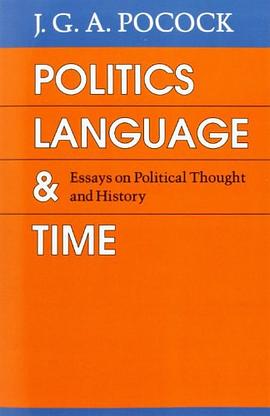
Essays on Political Thought and History
J. G. A. Pocock
简介
In his first essay, "Languages and Their Implications," J. G. A. Pocock announces the emergence of the history of political thought as a discipline apart from political philosophy. Traditionally, "history" of political thought has meant a chronological ordering of intellectual systems without attention to political languages; but it is through the study of those languages and of their changes, Pocock claims, that political thought will at last be studied historically.
Pocock argues that the solution has already been approached by, first, the linguistic philosophers, with their emphasis on the importance of language study to understanding human thought, and, second, by Thomas Kuhn's "The Structure of Scientific Revolutions," with its notion of controlling intellectual paradigms. Those paradigms within and through which the scientist organizes his intellectual enterprise may well be seen as analogous to the worlds of political discourse in which political problems are posed and political solutions are proffered. Using this notion of successive paradigms, Pocock demonstrates its effectiveness by analyzing a wide range of subjects, from ancient Chinese philosophy to Machiavelli, Hobbes, and Burke.
目录
Preface, 1989
1. Languages and Their Implications: The Transformation of the Study of Political Thought
2. Ritual, Language, Power: An Essay on the Apparent Political Meanings of Ancient Chinese Philosophy
3. Civic Humanism and Its Role in Anglo-American Thought
4. Machiavelli, Harrington and English Political Ideologies in the Eighteenth Century
5. Time, History and Eschatology in the Thought of Thomas Hobbes
6. Burke and the Ancient Constitution: A Problem in the History of Ideas
7. Time, Institutions and Action: An Essay on Traditions and Their Understanding
8. On the Non-Revolutionary Character of Paradigms: A Self-Criticism and Afterpiece