Mourning in Late Imperial China
Douban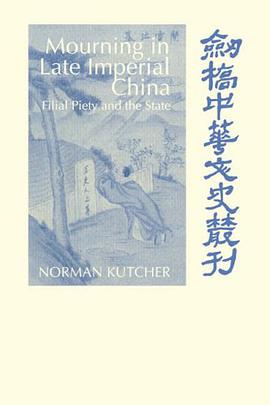
Filial Piety and the State
Norman Kutcher
résumé
As a conquest dynasty, Qing China's new Manchu leaders desperately needed to legitimize their rule. To win the approval of China's native elites, they developed an ambitious plan to return Confucianism to civil society. Filial piety, the core Confucian value, would once again be upheld by the state, and laborious and time-consuming mourning rituals, the touchstones of a well-ordered Confucian society, would be observed by officials throughout the empire. In this way, the emperor would be following the ancient dictate that he 'govern all-under-heaven with filial piety'. Norman Kutcher's study of mourning looks beneath the rhetoric to demonstrate how the state - unwilling to make the sacrifices that a genuine commitment to proper mourning demanded - quietly but forcefully undermined, not reinvigorated, the Confucian mourning system. With acute sensitivity to language and its changing meanings, Kutcher sheds light on a wide variety of issues that are of interest to historians of late Imperial China.
contenus
List of illustrations
Acknowledgements
A note on conventions
Reigns of Ming and Qing emperors
Introduction
1. Death and the state in imperial China: continuities
2. The reorientation of Ming attitudes toward mourning
3. The early Qing transformation of mourning practice
4. The bureaucratization of the Confucian li
5. The death of Xiaoxian and the crisis of Qianlong rule
6. Death and Chinese society
Select bibliography
Index