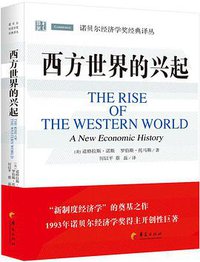
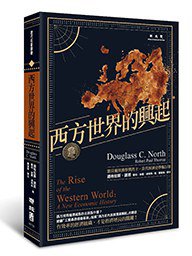
The Rise of the Western World
Douban
A New Economic History
Douglass C. North / Robert Paul Thomas
Sinossi
This is a landmark book on the impact of property rights on European economic development. Published over a quarter of a century ago, its stated goal is "... to suggest new paths for the study of European economic history rather than ... either [a detailed and exhaustive study or a precise empirical test that are the] ... standard formats" (p. vii). North and Thomas attempt to identify the elements that allowed the Western European economy to rise to affluence. Their argument is made transparent in Chapter One (Theory and Overview): the key to growth was and is an efficient economic system. Efficient in the sense that the system of property rights gives individuals incentives to innovate and produce, and, conversely inhibits those activities (rent-seeking, theft, arbitrary confiscation and/or excessive taxation) that reduce individual incentives. They argue that property rights are classic public goods because: (1) once a more efficient set of property rights is discovered the marginal cost of copying it is low (compared to the cost of discovering and developing it); (2) it is prohibitively expensive to prevent other political jurisdictions from emulating a more efficient set of property rights regardless of whether they contributed to their construction; (3) and finally, the idea of a set of property rights, like all ideas, is non-rival -- we can all consume the same idea and the "stock" of the idea is not diminished. These public good aspects lead them to conclude that there may be under investment in the attempts to create more efficient sets of property rights because the jurisdiction that invests in the development of property rights pays the entire cost of their development but receives only benefits that accrue to its jurisdiction, while other jurisdictions can get the benefits without any of the developmental costs. Thus, the problems of public goods and the "free riders."
contenuti
Table of Contents
Preface
Part I. Theory and Overview: 1. The issue
2. The overview
Part II. 900–1500: 3. Property rights in land and man
4. Economic conditions at the end of the Early Middle Ages
5. The High Middle Ages: a fronier movement
6. Thirteenth-century Europe
7. The fourteenth and fifteenth centuries
Part III. 1500–1700: 8. Fiscal policy and property rights
9. The Early Modern period
10. France and Spain - the also-rans
11. The Netherlands and successful economic growth
12. England
Epilogue
Bibliography
Index.