Bodies of Memory
Douban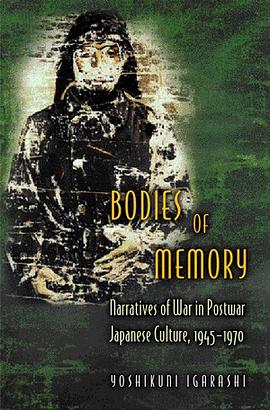
Narratives of War in Postwar Japanese Culture, 1945-1970
Yoshikuni Igarashi
Übersicht
Japan and the United States became close political allies so quickly after the end of World War II, that it seemed as though the two countries had easily forgotten the war they had fought. Here Yoshikuni Igarashi offers a provocative look at how Japanese postwar society struggled to understand its war loss and the resulting national trauma, even as forces within the society sought to suppress these memories. Igarashi argues that Japan's nationhood survived the war's destruction in part through a popular culture that expressed memories of loss and devastation more readily than political discourse ever could. He shows how the desire to represent the past motivated Japan's cultural productions in the first twenty-five years of the postwar period.
Japanese war experiences were often described through narrative devices that downplayed the war's disruptive effects on Japan's history. Rather than treat these narratives as obstacles to historical inquiry, Igarashi reads them along with counter-narratives that attempted to register the original impact of the war. He traces the tensions between remembering and forgetting by focusing on the body as the central site for Japan's production of the past. This approach leads to fascinating discussions of such diverse topics as the use of the atomic bomb, hygiene policies under the U.S. occupation, the monstrous body of Godzilla, the first Western professional wrestling matches in Japan, the transformation of Tokyo and the athletic body for the 1964 Tokyo Olympics, and the writer Yukio Mishima's dramatic suicide, while providing a fresh critical perspective on the war legacy of Japan.
Inhalt
Acknowledgements ix
Introduction 3
I. The Bomb, Hirohito, and History: The Foundamental Narrative of Postwar Relations between Japan and United States 19
II. The Age of the Body 47
III. A Nation that Never Is: Cultural Discourse on Japanese Uniqeness 73
IV. Naming the Unnameable 104
V. From the Anti-Security Treaty Movement to the Tokoyo Olympics: Transforming the Body, the Metropolis, and Memory 131
VI. Re-Presenting Trauma in Late-1960s Japan 164
Conclusion 199
Notes 211
Bibliography 253
Index 275