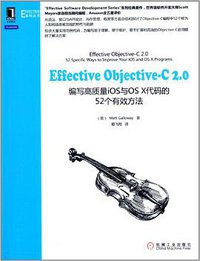
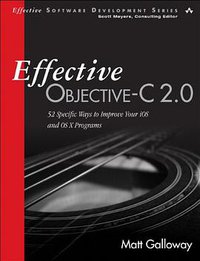
Effective Objective-C 2.0
Douban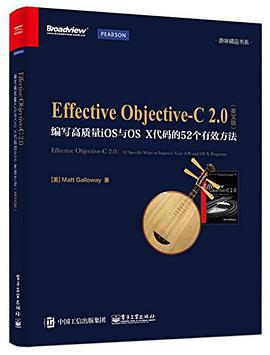
编写高质量iOS与OS X代码的52个有效方法
马特·加洛韦 (Matt Galloway)
overblik
《Effective Objective-C 2.0:编写高质量iOS与OS X代码的52个有效方法 英文版》不是在讲Objective-C语言的基础知识,而是要讲如何高效运用这门语言。《Effective Objective-C 2.0:编写高质量iOS与OS X代码的52个有效方法 英文版》共分7章,从7个方面总结和探讨了Objective-C编程中52个鲜为人知又容易被忽视的特性。第1章从整体上讲解Objective-C的核心概念;第2章讲述了与面向对象语言的重要特征(对象、消息和运行期)相关的行为;第3章介绍了如何编写适合与Objective-C搭配的类;第4章讲述协议与分类相关的技巧;第5章介绍内存管理的注意事项;第6章介绍块与大中枢派发(GrandCentralDispatch)相关的技巧;第7章总览了Cocoa和CocoaTouch系统框架,并深入研究了其中的某些类。
indhold
前言
致谢
关于作者
Chapter 1: Accustoming Yourself to Objective-C
Item 1: Familiarize Yourself with Objective-C’s Roots
Item 2: Minimize Importing Headers in Headers
Item 3: Prefer Literal Syntax over the Equivalent Methods
Item 4: Prefer Typed Constants to Preprocessor #define
Item 5: Use Enumerations for States, Options, and Status Codes
Chapter 2: Objects, Messaging, and the Runtime
Item 6: Understand Properties
Item 7: Access Instance Variables Primarily Directly When
Accessing Them Internally
Item 8: Understand Object Equality
Item 9: Use the Class Cluster Pattern to Hide Implementation Detail
Item 10: Use Associated Objects to Attach Custom Data to Existing Classes
Item 11: Understand the Role of objc_msgSend
Item 12: Understand Message Forwarding
Item 13: Consider Method Swizzling to Debug Opaque Methods
Item 14: Understand What a Class Object Is
Chapter 3: Interface and API Design
Item 15: Use Prefix Names to Avoid Namespace Clashes
Item 16: Have a Designated Initializer
Item 17: Implement the description Method
Item 18: Prefer Immutable Objects
Item 19: Use Clear and Consistent Naming
Item 20: Prefix Private Method Names
Item 21: Understand the Objective-C Error Model
Item 22: Understand the NSCopying Protocol
Chapter 4: Protocols and Categories
Item 23: Use Delegate and Data Source Protocols for Interobject Communication
Item 24: Use Categories to Break Class Implementations into Manageable Segments
Item 25: Always Prefix Category Names on Third-Party Classes
Item 26: Avoid Properties in Categories
Item 27: Use the Class-Continuation Category to Hide Implementation Detail
Item 28: Use a Protocol to Provide Anonymous Objects
Chapter 5: Memory Management
Item 29: Understand Reference Counting
Item 30: Use ARC to Make Reference Counting Easier
Item 31: Release References and Clean Up Observation State Only in dealloc
Item 32: Beware of Memory Management with Exception-Safe Code
Item 33: Use Weak References to Avoid Retain Cycles
Item 34: Use Autorelease Pool Blocks to Reduce High-Memory Waterline
Item 35: Use Zombies to Help Debug Memory-Management Problems
Item 36: Avoid Using retainCount
Chapter 6: Blocks and Grand Central Dispatch
Item 37: Understand Blocks
Item 38: Create typedefs for Common Block Types
Item 39: Use Handler Blocks to Reduce Code Separation
Item 40: Avoid Retain Cycles Introduced by Blocks Referencing the Object Owning Them
Item 41: Prefer Dispatch Queues to Locks for Synchronization
Item 42: Prefer GCD to performSelector and Friends
Item 43: Know When to Use GCD and When to Use Operation Queues
Item 44: Use Dispatch Groups to Take Advantage of Platform Scaling
Item 45: Use dispatch_once for Thread-Safe Single-Time Code Execution
Item 46: Avoid dispatch_get_current_queue
Chapter 7: The System Frameworks
Item 47: Familiarize Yourself with the System Frameworks
Item 48: Prefer Block Enumeration to for Loops
Item 49: Use Toll-Free Bridging for Collections with Custom Memory-Management Semantics
Item 50: Use NSCache Instead of NSDictionary for Caches
Item 51: Keep initialize and load Implementations Lean
Item 52: Remember that NSTimer Retains Its Target
Index