Info-Gap Decision Theory, Second Edition
Douban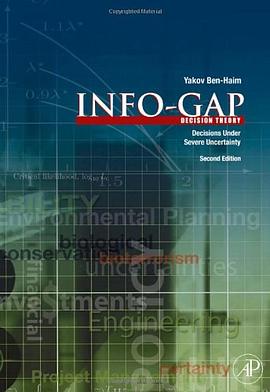
Decisions Under Severe Uncertainty
Yakov Ben-Haim
Sinossi
Everyone makes decisions, but not everyone is a decision analyst. A decision analyst uses quantitative models and computational methods to formulate decision algorithms, assess decision performance, identify and evaluate options, determine trade-offs and risks, evaluate strategies for investigation, and so on. This book is written for decision analysts. The term 'decision analyst' covers an extremely broad range of practitioners. Virtually all engineers involved in design (of buildings, machines, processes, etc.) or analysis (of safety, reliability, feasibility, etc.) are decision analysts, usually without calling themselves by this name. In addition to engineers, decision analysts work in planning offices for public agencies, in project management consultancies, they are engaged in manufacturing process planning and control, in financial planning and economic analysis, in decision support for medical or technological diagnosis, and so on and on. Decision analysts provide quantitative support for the decision-making process in all areas where systematic decisions are made. This second edition entails changes of several sorts. First, info-gap theory has found application in several new areas - especially biological conservation, economic policy formulation, preparedness against terrorism, and medical decision-making. Pertinent new examples have been included. Second, the combination of info-gap analysis with probabilistic decision algorithms has found wide application. Consequently 'hybrid' models of uncertainty, which were treated exclusively in a separate chapter in the previous edition, now appear throughout the book as well as in a separate chapter. Finally, info-gap explanations of robust-satisficing behavior, and especially the Ellsberg and Allais 'paradoxes', are discussed in a new chapter together with a theorem indicating when robust-satisficing will have greater probability of success than direct optimizing with uncertain models. This title includes: new theory developed systematically; many examples from diverse disciplines; realistic representation of severe uncertainty; multi-faceted approach to risk; and, quantitative model-based decision theory.