Open 16
Douban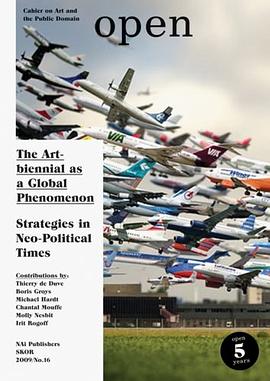
The Art Biennial as a Global Phenomenon Strategies in Neo-Political Times
Michel Hardt / Boris Groys …
Übersicht
Not only is there a boom in international art biennials, but they are also increasingly deployed for developing and marketing cities and regions. In order to compensate for this, political issues are more and more often put on the agenda. Can biennials really represent an alternative political voice? This extra anniversary issue of Open contains a number of lectures delivered at the debate on this issue in October 2008 in connection with the first Brussels Biennial. Together with supplementary texts, a ‘reader’ has been created in which the biennial as a global phenomenon is analysed and approached not only in terms of an art theoretical discourse or curatorial practice, but also on the basis of more sociological and politico-philosophical points of view.
Pascal Gielen analyses the problematic sides of the art biennial as a global phenomenon.
Michael Hardt questions the role of the artist in disseminating communality.
Chantal Mouffe reveals how artistic practices can break through existing power structures.
Thierry de Duve wants to restore aesthetic values to the viewing of art in a globalized world.
According to Boris Groys, the biennial, just like the installation, creates a space that serves as a model for a new political world order.
Simon Sheikh employs the notion of ‘politics of transition’ in order to escape neoliberal ideology.
Brian Holmes focusses on the striking concept of the Sixth Biennial of Taipei.
Charles Esche and Maria Hlavajova explain their own contribution to the Brussels Biennial.
Irit Rogoff’s project 'Geo-Cultures' examines the biennial as a site where local knowledge is exchanged with conditions elsewhere.