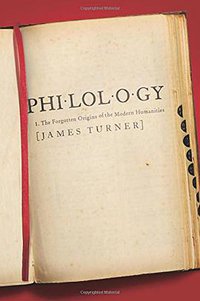
Philology
Douban
The Forgotten Origins of the Modern Humanities
James Turner
résumé
Many today do not recognize the word, but "philology" was for centuries nearly synonymous with humanistic intellectual life, encompassing not only the study of Greek and Roman literature and the Bible but also all other studies of language and literature, as well as religion, history, culture, art, archaeology, and more. In short, philology was the queen of the human sciences. How did it become little more than an archaic word? In Philology, the first history of Western humanistic learning as a connected whole ever published in English, James Turner tells the fascinating, forgotten story of how the study of languages and texts led to the modern humanities and the modern university.
This compelling narrative traces the development of humanistic learning from its beginning among ancient Greek scholars and rhetoricians, through the Middle Ages, Renaissance, and Enlightenment, to the English-speaking world of the nineteenth and early twentieth centuries. Turner shows how evolving researches into the texts, languages, and physical artifacts of the past led, over many centuries, to sophisticated comparative methods and a deep historical awareness of the uniqueness of earlier ages. But around 1800, he explains, these interlinked philological and antiquarian studies began to fragment into distinct academic fields. These fissures resulted, within a century or so, in the new, independent "disciplines" that we now call the humanities. Yet the separation of these disciplines only obscured, rather than erased, their common features.
The humanities today face a crisis of relevance, if not of meaning and purpose. Understanding their common origins--and what they still share--has never been more urgent.
contenus
Prologue ix
Conventions xix
Acknowledgments xxiii
PART I. FROM THE FIRST PHILOLOGISTS TO 1800 1
1. "Cloistered Bookworms, Quarreling Endlessly in the Muses' Bird-Cage": From Greek Antiquity to circa 1400 3
2. "A Complete Mastery of Antiquity": Renaissance, Reformation, and Beyond 33
3. "A Voracious and Undistinguishing Appetite": British Philology to the Mid-Eighteenth Century 65
4. "Deep Erudition Ingeniously Applied": Revolutions of the Later Eighteenth Century 91
PART II. ON THE BRINK OF THE MODERN HUMANITIES, 1800 TO THE MID-NINETEENTH CENTURY 123
5. "The Similarity of Structure Which Pervades All Languages": From Philology to Linguistics, 1800-1850 125
6. "Genuinely National Poetry and Prose": Literary Philology and Literary Studies, 1800-1860 147
7. "An Epoch in Historical Science": The Civilized Past, 1800-1850 167
I. Altertumswissenschaft and Classical Studies 168
II. Archaeology 184
III. History 197
8. "Grammatical and Exegetical Tact": Biblical Philology and Its Others, 1800-1860 210
PART III. THE MODERN HUMANITIES IN THE MODERN UNIVERSITY, THE MID-NINETEENTH TO THE TWENTIETH CENTURY 231
9. "This Newly Opened Mine of Scientific Inquiry": Between History and Nature: Linguistics after 1850 236
10. "Painstaking Research Quite Equal to Mathematical Physics": Literature, 1860-1920 254
11. "No Tendency toward Dilettantism": The Civilized Past after 1850 274
I. 'Classics' Becomes a Discipline 275
II. History 299
III. Art History 310
12. "The Field Naturalists of Human Nature": Anthropology Congeals into a Discipline, 1840-1910 328
13. "The Highest and Most Engaging of the Manifestations of Human Nature": Biblical Philology and the Rise of Religious Studies after 1860 357
I. The Fate of Biblical Philology 357
II. The Rise of Comparative Religious Studies 368
Epilogue 381
Notes 387
Works Cited 453
Index 509