Language Complexity as an Evolving Variable (Studies in the Evolution of Language)
Douban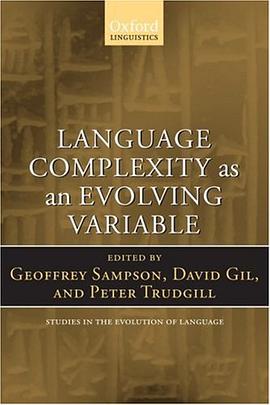
Sampson, Geoffrey (EDT)/ Gil, David (EDT)/ Trudgill, Peter (EDT)
sinopsis
This book presents a challenge to the widely-held assumption that human languages are both similar and constant in their degree of complexity. For a hundred years or more the universal equality of languages has been a tenet of faith among most anthropologists and linguists. It has been frequently advanced as a corrective to the idea that some languages are at a later stage of evolution than others. It also appears to be an inevitable outcome of one of the central axioms of generative linguistic theory: that the mental architecture of language is fixed and is thus identical in all languages and that whereas genes evolve languages do not. Language Complexity as an Evolving Variable reopens the debate. Geoffrey Sampson's introductory chapter re-examines and clarifies the notion and theoretical importance of complexity in language, linguistics, cognitive science, and evolution. Eighteen distinguished scholars from all over the world then look at evidence gleaned from their own research in order to reconsider whether languages do or do not exhibit the same degrees and kinds of complexity. They examine data from a wide range of times and places.They consider the links between linguistic structure and social complexity and relate their findings to the causes and processes of language change. Their arguments are frequently controversial and provocative; their conclusions add up to an important challenge to conventional ideas about the nature of language. The authors write readably and accessibly with no recourse to unnecessary jargon. This fascinating book will appeal to all those interested in the interrelations between human nature, culture, and language.