Overview
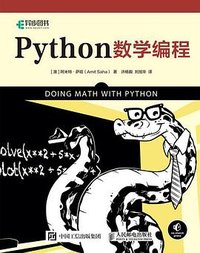
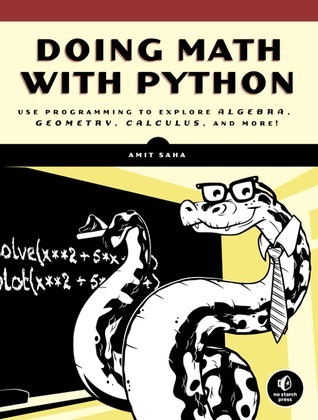
In Doing Math with Python you'll learn to how to use the Python programming language as a tool to delve into math concepts. Python is easy to learn, and it's perfect for exploring topics like statistics, geometry, probability, and calculus. You’ll learn to write programs to find derivatives, solve equations graphically, manipulate algebraic expressions, even examine projectile motion.
Rather than crank through tedious calculations by hand, you'll learn how to use Python functions and modules to handle the number crunching while you focus on the principles behind the math. Exercises throughout teach fundamental programming concepts, like using functions, handling user input, and reading and manipulating data. As you learn to think computationally, you'll discover new ways to explore and think about math, and gain valuable programming skills that you can use to continue your study of math and computer science.
If you’re interested in math but have yet to dip into programming, you’ll find that Python makes it easy to go deeper into the subject—let Python handle the tedious work while you spend more time on the math.
contents
Table of contents
Introduction
Chapter 1: Working with Numbers
Chapter 2: Visualizing Data with Graphs
Chapter 3: Describing Data with Statistics
Chapter 4: Algebra and Symbolic Math with SymPy
Chapter 5: Playing with Sets and Probability
Chapter 6: Drawing Geometric Shapes and Fractals
Chapter 7: Solving Calculus Problems
Afterword
Appendix A: Software Installation
Appendix B: Overview of Python Topics
View the detailed Table of Contents (PDF)
View the Index (PDF)