Global Rivalries
Douban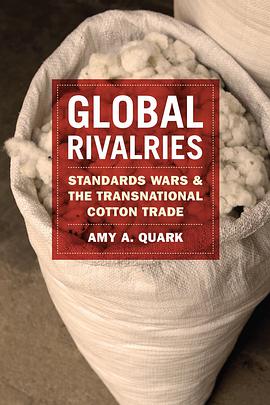
Standards Wars and the Transnational Cotton Trade
Amy A. Quark
visão geral
As the economies of China, India, and other Asian nations continue to grow, these countries are seeking greater control over the rules that govern international trade. Setting the rules carries with it the power to establish advantage, so it’s no surprise that everyone wants a seat at the table—or that negotiations over rules often result in stalemates at meeting of the World Trade Organization.
Nowhere is the conflict over rule setting more evident than in the simmering “standards wars” over the rules that define quality and enable the adjudication of disputes. In Global Rivalries, Amy A. Quark explores the questions of how rules are made, who makes them, and how they are enforced, using the lens of cotton—a simple commodity that has become a poignant symbol of both the crisis of Western rule making power and the potential for powerful new rivals to supplant it. Quark traces the strategies for influencing rule making processes employed not only by national governments but also by transnational corporations, fiber scientists, and trade associations from around the globe. Quark analyzes the efficacy of their approaches and the implications for more marginal actors in the cotton trade, including producers in West Africa.
By placing the current contest within the historical development of the global capitalist system, Global Rivalries highlights a fascinating interaction of politics and economics.
conteúdos
List of Acronyms
Acknowledgments
Chapter One: Introduction
Chapter Two: Standards Wars and the Original Competing Kings of Cotton
Chapter Three: A Project of Uneven Liberalization
Chapter Four: The World Trade Organization and the New Competing Kings of Cotton
Chapter Five: Imitate and Overtake?
Chapter Six: Switching Tracks
Chapter Seven: Conclusion
Notes
References
Index