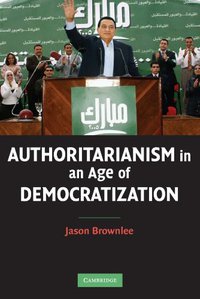
Authoritarianism in an Age of Democratization
Douban
Jason Brownlee
Sinossi
"Why does conducting elections sometimes undermine authoritarian regimes and sometimes seem to fortify them? Jason Brownlee answers this timely and provocative question in his study of four countries where elections produced unexpected outcomes: Egypt, Iran, Malaysia and the Philippines. From his close and careful reading of these electoral experiments, Brownlee concludes that their outcomes were shaped by the strength and solidity of the ruling parties. For scholars, students and policymakers alike, this salutary emphasis on the institutions that sustain and betray political regimes in transition is a valuable contribution, not only to the political science of democratization, but also to the policy debates about democracy promotion." -Lisa Anderson, Columbia University "Do elections in authoritarian states inevitably lead towards democracy, or do they serve as a safety valve allowing dictators to tighten their holds? Do even rigged elections indicate that some political competition is occurring, despite the regime's tight grip? These are the questions that Jason Brownlee tackles in his fascinating four-country study. Looking carefully at different historical trajectories of political parties, he unravels a central dilemma: why some authoritarian regimes have survived in an age of democratization, while others have given way to true democratic practices." -Joel Migdal, University of Washington "Brownlee's work serves as an autopsy of departed dictatorships and a diagnosis of the past and future health of persistent autocracies. He skillfully deploys an ingenious research design and abundant evidence from four countries to identify ruling parties that contain elite conflict as the main source of authoritarian stability. Yet the maintenance of ruling parties is medicine that some autocrats refuse to take. Fearing that they will become institutional bases of opposition, some ruling groups dismantle their own parties. In these cases, Brownlee demonstrates, uncontained elite conflict motivates the emergence of soft liners who may become leaders of democratic transitions. This ambitious and well-written book provides many important lessons about the origins and effects of political institutions. It is a 'must read' for scholars of regime dynamics." -David Waldner, University of Virginia "This is a welcome addition to recent work emphasizing the importance of institutions in nondemocratic regimes. [...]The care with which the author traces the theoretical claims through the empirical narratives is the book's greatest strength. What he finds within the cases themselves opens up potentially interesting new puzzles for future research." -Jennifer Gandhi, Emory University, Perspectives on Politics