The Creation of the French Royal Mistress
Google Books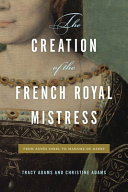
From Agnès Sorel to Madame Du Barry
Tracy Adams / Christine Adams
Sinossi
Kings throughout medieval and early modern Europe had extraconjugal sexual partners. Only in France, however, did the royal mistress become a quasi-institutionalized political position. This study explores the emergence and development of the position of French royal mistress through detailed portraits of nine of its most significant incumbents: Agn s Sorel, Anne de Pisseleu d'Heilly, Diane de Poitiers, Gabrielle d'Estr es, Fran oise Louise de La Baume Le Blanc, Fran oise Ath na s de Rochechouart de Mortemart, Fran oise d'Aubign , Jeanne-Antoinette Poisson, and Jeanne B cu.Beginning in the fifteenth century, key structures converged to create a space at court for the royal mistress. The first was an idea of gender already in place: that while women were legally inferior to men, they were men's equals in competence. Because of their legal subordinancy, queens were considered to be the safest regents for their husbands, and, subsequently, the royal mistress was the surest counterpoint to the royal favorite. Second, the Renaissance was a period during which people began to experience space as theatrical. This shift to a theatrical world opened up new ways of imagining political guile, which came to be positively associated with the royal mistress. Still, the role had to be activated by an intelligent, charismatic woman associated with a king who sought women as advisors. The fascinating particulars of each case are covered in the chapters of this book.Thoroughly researched and compellingly narrated, this important study explains why the tradition of a politically powerful royal mistress materialized at the French court, but nowhere else in Europe. It will appeal to anyone interested in the history of the French monarchy, women and royalty, and gender studies.