The Shock Doctrine
WikiData Google Livros Skybridge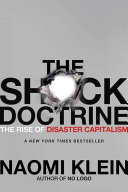
The Rise of Disaster Capitalism
visão geral
The bestselling author of No Logo shows how the global "free market" has exploited crises and shock for three decades, from Chile to Iraq
In her groundbreaking reporting, Naomi Klein introduced the term "disaster capitalism." Whether covering Baghdad after the U.S. occupation, Sri Lanka in the wake of the tsunami, or New Orleans post-Katrina, she witnessed something remarkably similar. People still reeling from catastrophe were being hit again, this time with economic "shock treatment," losing their land and homes to rapid-fire corporate makeovers.
The Shock Doctrine retells the story of the most dominant ideology of our time, Milton Friedman's free market economic revolution. In contrast to the popular myth of this movement's peaceful global victory, Klein shows how it has exploited moments of shock and extreme violence in order to implement its economic policies in so many parts of the world from Latin America and Eastern Europe to South Africa, Russia, and Iraq.
At the core of disaster capitalism is the use of cataclysmic events to advance radical privatization combined with the privatization of the disaster response itself. Klein argues that by capitalizing on crises, created by nature or war, the disaster capitalism complex now exists as a booming new economy, and is the violent culmination of a radical economic project that has been incubating for fifty years.
outras edições (8)
-
 休克主义 广西师范大学出版社 2010
-
 La Stratégie du choc : La Montée d'un capitalisme du désastre Babel 2010
-
 震撼主義 時報文化 2009
-
 The Shock Doctrine Picador 2008
-
 The Shock Doctrine Penguin Books Ltd 2008
-
 The Shock Doctrine Metropolitan Books 2007
-
 The Shock Doctrine: The Rise of Disaster Capitalism Metropolitan Books 2007
-
 The Shock Doctrine Alfred A. Knopf Canada 2007