Understanding Arguments (9/e)
Douban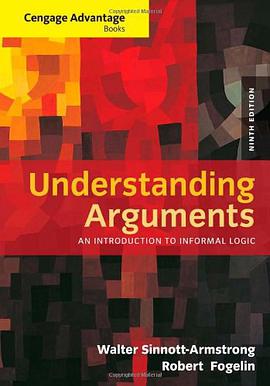
An Introduction to Informal Logic
Walter Sinnott-Armstrong / Robert J. Fogelin
Übersicht
UNDERSTANDING ARGUMENTS: AN INTRODUCTION TO INFORMAL LOGIC, 9E shows readers how to construct arguments in everyday life, using everyday language. In addition, this easy-to-read textbook also devotes three chapters to the formal aspects of logic including forms of argument, as well as propositional, categorical, and quantificational logic. Plus, this edition helps readers apply informal logic to legal, moral, scientific, religious, and philosophical scenarios, too.
Lively and clear prose, with a touch of humor.
Exercises, discussion questions, chapter objectives, and readings are drawn from a variety of disciplines and genres to test analytical skills.
Covers the rudiments of formal logic and forms of argument, such as inference to the best explanation, that other textbooks on informal logic overlook.
Detailed applications to legal, moral, scientific, religious, and philosophical arguments help students understand argument in a wide variety of contexts.
Presents a unified theory of the nature of argument and language, emphasizing pragmatic applications.
Inhalt
Preface.
PART I: HOW TO ANALYZE ARGUMENTS.
1. Uses of Arguments.
2. The Web of Language.
3. The Language of Argument.
4. The Art Of Close Analysis.
5. Deep Analysis.
PART II: HOW TO EVALUATE ARGUMENTS: DEDUCTIVE STANDARDS.
6. Propositional Logic.
7. Categorical Logic.
PART III: HOW TO EVALUATE ARGUMENTS: INDUCTIVE STANDARDS.
8. Arguments To And From Generalizations.
9. Causal Reasoning.
10. Inference To The Best Explanation And From Analogy.
11. CHANCES.
12. CHOICES.
PART IV: FALLACIES.
13. Fallacies Of Vagueness.
14. Fallacies Of Ambiguity.
15. Fallacies Of Relevance.
16. Fallacies Of Vacuity.
17. Refutation.
PART V: AREAS OF ARGUMENTATION.
18. Legal Reasoning.
19. Moral Reasoning.
20. Scientific Reasoning.
21. Religious Reasoning.
22. Philosophical Reasoning.
Credits.
Index.