Philosophy Of New Music
豆瓣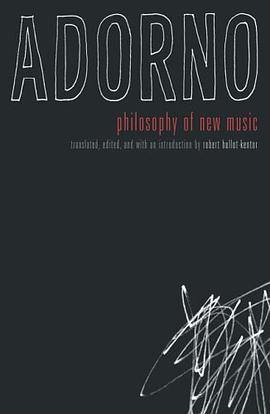
Theodor W. Adorno Hullot-Kentor, Robert
簡介
In 1947 Theodor Adorno, one of the seminal European philosophers of the postwar years, announced his return after exile in the United States to a devastated Europe by writing Philosophy of New Music. Intensely polemical from its first publication, every aspect of this work was met with extreme reactions, from stark dismissal to outrage. Even Schoenberg reviled it. Despite the controversy, Philosophy of New Music became highly regarded and widely read among musicians, scholars, and social philosophers. Marking a major turning point in his musicological philosophy, Adorno located a critique of musical reproduction as internal to composition itself, rather than as a matter of the reproduction of musical performance. Consisting of two distinct essays, "Schoenberg and Progress" and "Stravinsky and Reaction," this work poses the musical extremes in which Adorno perceived the struggle for the cultural future of Europe: between human emancipation and barbarism, between the compositional techniques and achievements of Schoenberg and Stravinsky. In this completely new translation--presented along with an extensive introduction by distinguished translator Robert Hullot-Kentor--Philosophy of New Music emerges as an indispensable key to the whole of Adorno's illustrious and influential oeuvre. Theodor W. Adorno (1903-1969) was the leading figure of the Frankfurt school of critical theory. He authored more than twenty volumes, including Negative Dialectics (1982), Philosophy of Modern Music (1980), Kierkegaard (Minnesota, 1989), Dialectic of Enlightenment (1975) with Max Horkheimer, and Aesthetic Theory (Minnesota, 1997). Robert Hullot-Kentor has taught at Harvard and Stanford universities and written widely on Adorno. He has translated various works of Adorno, including Aesthetic Theory.