The Filing Cabinet
Douban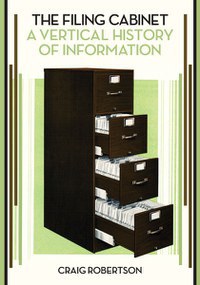
A Vertical History of Information
Craig Robertson
overblik
The ubiquity of the filing cabinet in the twentieth-century office space, along with its noticeable absence of style, has obscured its transformative role in the histories of both information technology and work. In the first in-depth history of this neglected artifact, Craig Robertson explores how the filing cabinet profoundly shaped the way that information and data have been sorted, stored, retrieved, and used.
Invented in the 1890s, the filing cabinet was a result of the nineteenth-century faith in efficiency. Previously, paper records were arranged haphazardly: bound into books, stacked in piles, curled into slots, or impaled on spindles. The filing cabinet organized loose papers in tabbed folders that could be sorted alphanumerically, radically changing how people accessed, circulated, and structured information.
Robertson’s unconventional history of the origins of the information age posits the filing cabinet as an information storage container, an “automatic memory” machine that contributed to a new type of information labor privileging manual dexterity over mental deliberation. Gendered assumptions about women’s nimble fingers helped to naturalize the changes that brought women into the workforce as low-level clerical workers. The filing cabinet emerges from this unexpected account as a sophisticated piece of information technology and a site of gendered labor that with its folders, files, and tabs continues to shape how we interact with information and data in today’s digital world.
indhold
Contents
Preface: Discovering the Power of the Filing Cabinet
Introduction: Making Paper Work Efficiently
Part 1. The Cabinet
1. Verticality: A Skyscraper for the Office
2. Integrity: A Steel Container for Paper
3. Cabinet Logic: A Structure for Efficiency and Information
Part II. Filing
4. Granular Certainty: Bringing System to the Office
5. Automatic Filing: Delegating Memory to a Machine
6. The Ideal File Clerk: Controlling Work in the Office
7. Planned Storage: Domesticating Cabinet Logic
Afterword: File Cabinets, Out of Time and Out of Place
Acknowledgments
Notes
Index