Critique of Cynical Reason
Douban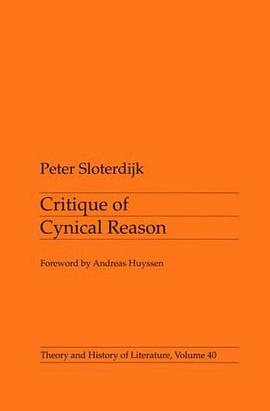
Peter Sloterdijk Michael Eldred
résumé
A philosophical treatise which finds cynicism the dominant mode in contemporary culture.
In 1983, two centuries after the publication of Kant’s Critique of Pure Reason, another philosophical treatise—polemical in nature, with a title that consciously and disrespectfully alludes to the earlier work—appeared in West Germany. Peter Sloterdijk’s Critique of Cynical Reason stirred both critical acclaim and consternation and attracted a wide readership, especially among those who had come of age in the 1960’s. Sloterdijk’s finds cynicism the dominant mode in contemporary culture, in personal institutional settings; his book is less a history of the impulse than an investigation of its role in the postmodern 1970s and 1980s, among those whose earlier hopes for social change had crumbled and faded away. Sloterdijk thus brings into cultural and political discourse an issue which, though central to the mood of a generation, has remained submerged throughout the current debate about modernity and postmodernity.
With Adorno and Horkeimer’s Dialectic of Enlightenment as his primary jumping-off point, Sloterdijk also draws upon, and contends with, the poststructuralist concepts of Deleuze and Guattari. He defines cynicism as enlightened false consciousness—a sensibility “well off and miserable at the same time,” able to function in the workaday world yet assailed by doubt and paralysis; and, as counterstrategy, proposes the cynicism of antiquity—the sensuality and loud, satiric laughter of Diogenes. Above all, Sloterdijk is determined to resist the amnesia inherent in cynicism. The twentieth-century German historical experience lies behind his work, which closes with a brilliant essay on the Weimar Republic—the fourteen years between a lost war and Hitler’s ascent to power, and a time when the cynical mode first achieved cultural dominance.