A Princely Impostor?: The Strange and Universal History of the Kumar of Bhawal
Goodreads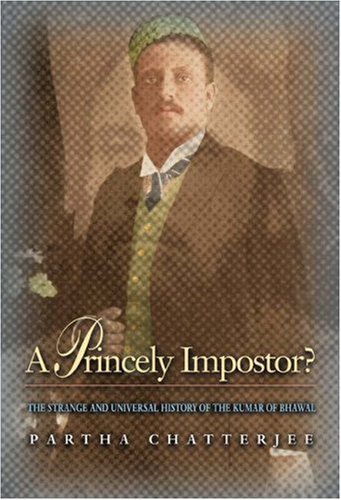
Overview
In 1921 a traveling religious man appeared in eastern British Bengal. Soon residents began to identify this half-naked and ash-smeared sannyasi as none other than the Second Kumar of Bhawal--a man believed to have died twelve years earlier, at the age of twenty-six. So began one of the most extraordinary legal cases in Indian history. The case would rivet popular attention for several decades as it unwound in courts from Dhaka and Calcutta to London.
This narrative history tells an incredible story replete with courtroom drama, sexual debauchery, family intrigue, and squandered wealth. With a novelist's eye for interesting detail, Partha Chatterjee sifts through evidence found in official archives, popular songs, and backstreet Bangladeshi bookshops. He evaluates the case of the man claiming, with the support of legions of tenants and relatives, to be the long-lost Kumar. And he considers the position of the sannyasi's detractors, including the colonial government and the Kumar's young widow, who resolutely refused to meet the man she denounced as an impostor.
Along the way, Chatterjee introduces us to a fascinating range of human character, gleans insights into the nature of human identity, and examines the relation between scientific evidence, legal truth, and cultural practice. The story he tells unfolds alongside decades of Indian history. Its plot is shaped by changing gender and class relations and punctuated by critical historical events, including the onset of World War II, the Bengal famine of 1943, and the Great Calcutta Killings. And by identifying the earliest erosion of colonialism and the growth of nationalist thinking within the organs of colonial power, Chatterjee also gives us a secret history of Indian nationalism.