The Equation That Couldn't Be Solved
Douban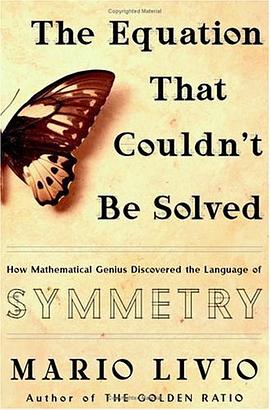
How Mathematical Genius Discovered the Language of Symmetry
Mario Livio
Sinossi
What do the music of J. S. Bach, the basic forces of nature, Rubik's Cube, and the selection of mates have in common? They are all characterized by certain symmetries. Symmetry is the concept that bridges the gap between science and art, between the world of theoretical physics and the everyday world we see around us. Yet the "language" of symmetry--group theory in mathematics--emerged from a most unlikely source: an equation that couldn't be solved.
Over the millennia, mathematicians solved progressively more difficult algebraic equations until they came to what is known as the quintic equation. For several centuries it resisted solution, until two mathematical prodigies independently discovered that it could not be solved by the usual methods, thereby opening the door to group theory. These young geniuses, a Norwegian named Niels Henrik Abel and a Frenchman named Evariste Galois, both died tragically. Galois, in fact, spent the night before his fatal duel (at the age of twenty) scribbling another brief summary of his proof, at one point writing in the margin of his notebook "I have no time."
The story of the equation that couldn't be solved is a story of brilliant mathematicians and a fascinating account of how mathematics illuminates a wide variety of disciplines. In this lively, engaging book, Mario Livio shows in an easily accessible way how group theory explains the symmetry and order of both the natural and the human-made worlds.