Property Law
Douban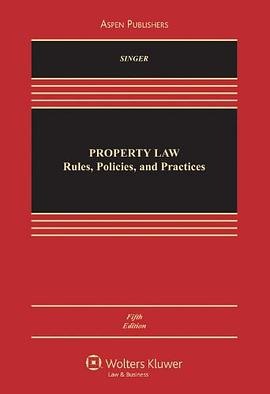
Rules, Policies and Practices, 5th Edition
Joseph William Singer
overblik
This hugely successful cases-and-problems book, acclaimed for its textual clarity and socially progressive but evenhanded perspective and its contemporary, up-to-date character, is easily distinguished from other property casebooks through its explanations of the social ramifications of property law; its inclusion of numerous statutes and its emphasis on both statutory interpretation and the interrelationship between common law and statutes and regulation; its comprehensive treatment of public accommodations and fair housing law, current tribal property issues, and property in human bodies; and its use of the problem method to teach legal reasoning and lawyering skills.
Outstanding features of Property Law: Rules, Policies, and Practices, written by Professor Joseph William Singer, a highly regarded authority in the field, include:
well-written notes with clear explanations of the law so students can learn complicated rules easily
strong coverage of civil rights law (fair housing and public accommodations law)
strong coverage of statutes, regulations, and statutory interpretation
problem-oriented approach, applying concepts, rules, and doctrines to new situations one might find in practice, with problems updated to be current
recent cases and interesting fact situations
accompanied by a Teacher’s Manual and a website
Meticulously and thoughtfully updated and refined, the Fifth Edition offers:
reorganized chapter sequence
Part I, renamed “Property in a Free and Democratic Society,” links the estates system to the anti-feudal policy and to the current consumer protection orientation of the subprime crisis
reverses the order of previous Chapter 1 and Chapter 2 to begin with the easy-to-understand trespass material on the right to exclude and limits on the right to exclude created by common law, statutes, and constitutional law. These chapters teach from the very beginning that property rights are limited rather than absolute, that they involve social relationships, not just control over things, and that property law is defined by both common law and statutes
all-new Chapter 2, “The Framework of Property Relations in a Democracy,” shows the connection between property law rules designed to prevent the re-emergence of feudalism and regulations designed to respond to the current subprime mortgage crisis. New material on subprime mortgages demonstrates how we can understand all of property law by thinking about the lessons of the subprime crisis
Chapter 3, now entitled “Competing Claims to Property,” focuses partly on how property rights in land were historically created and partly on how property claims emerge today. Most important, it treats these issues as involving competing claims to property
new Part II, entitled “What Can Be Owned?,” puts the intellectual property chapter and the chapter on property in persons (renamed) at the beginning of the book as an introduction to the problem of defining what can be owned
material on tribal property is now integrated into a coherent treatment that addresses both the legacy of conquest and contemporary legal issues
new cases, among them:
Commonwealth v. Fremont Investment & Loan (on subprime lending)
Warner Bros. Entertainment, Inc. & J.K. Rowling v. RDR Books (on the Harry Potter copyright case)
Wilcox v. Stroub (on ownership of the papers of Confederate governors of South Carolina)
timely updates throughout, among them:
information on Measure 37 in Oregon (and Measure 49)
changes in mortgages law following the subprime crisis
changes in adverse possession law in Colorado and New York
fuller coverage of the Uniform Residential Landlord and Tenant Act
changes in the law of same sex marriage
state legislative and constitutional responses to Kelo and substantial changes in the rule against perpetuities
reorganization of some of the takings materials to be fully consistent with recently emerging Supreme Court standards in Lingle
more problems involving problem solving or planning rather than focusing exclusively on litigation
a Website that includes cases and problems that are deleted from the fourth edition so faculty who want to continue to use them can do so