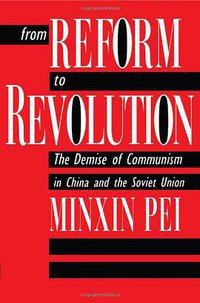
From Reform to Revolution
Douban
The Demise of Communism in China and the Soviet Union
Übersicht
The demise of communism in the former Soviet Union and the massive political and economic changes in China are two major transformations of the 20th century. Two central questions are emerging: Why did different communist systems experience different patterns of transition? Why did partial reforms in the Soviet Union and China turn into revolutions? This analytical and empirical study shows that patterns of regime transition in communist states depend on the countries' pre-existing social structures and political and economic institutions. Minxin Pei identifies the rapid mobilization of previously excluded social groups during the reform phase as the most powerful explanation for the revolutionary outcome of initially limited political and economic reforms in the Soviet Union and China. Pei uses comparative data to analyze the different routes of transition to democracy and a market economy in the Soviet Union, China, and, to a lesser extent, other former communist states in Eastern Europe and Asia. The theory is empirically tested in four case studies of changes in China and the Soviet Union - two on the development of the private sector in each country and two on the liberalization of the mass media. The author concludes with statements about regime transition from communism. He rejects the idealistic notion that democratization can, by itself, remove the structural obstacles to economic transformation, and he sees high economic and political costs as unavoidable in transition from communism along either the Soviet or the Chinese path. In comparing Soviet and Chinese transition costs, however, he implicitly endorses the evolutionary changes taking place in China and expresses strong doubt about the revolutionary changes that have occurred in the former Soviet Union.
Inhalt
Intorduction
1. Regime Transition in Communist States
2. Explaining the Tocquville Paradox
3. China’s Capitalist Revolution
4. The private Sector under Perestroika
5. The Self-Liberalization of the China’s Mass Media
6. The Liberal Takeover of the Soviet Mass Media under Glasnost
Conclusion