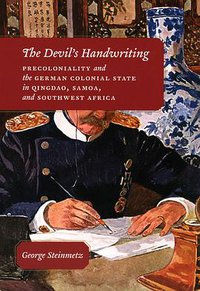
The Devil's Handwriting
豆瓣
Precoloniality and the German Colonial State in Qingdao, Samoa, and Southwest Africa
George Steinmetz
簡介
Germany’s overseas colonial empire was relatively short lived, lasting from 1884 to 1918. During this period, dramatically different policies were enacted in the colonies: in Southwest Africa, German troops carried out a brutal slaughter of the Herero people; in Samoa, authorities pursued a paternalistic defense of native culture; in Qingdao, China, policy veered between harsh racism and cultural exchange.
Why did the same colonizing power act in such differing ways? In The Devil’s Handwriting, George Steinmetz tackles this question through a brilliant cross-cultural analysis of German colonialism, leading to a new conceptualization of the colonial state and postcolonial theory. Steinmetz uncovers the roots of colonial behavior in precolonial European ethnographies, where the Hereros were portrayed as cruel and inhuman, the Samoans were idealized as “noble savages,” and depictions of Chinese culture were mixed. The effects of status competition among colonial officials, colonizers’ identification with their subjects, and the different strategies of cooperation and resistance offered by the colonized are also scrutinized in this deeply nuanced and ambitious comparative history.
目錄
List of Illustrations
Preface
Acknowledgements
Abbreviations
CHAPTER 1
Introduction: Ethnography and the Colonial State
Three Colonies
Making Sense of Colonial Variations
The Specificity of the Colonial State
Precolonial Mimicry and the Central Role of Native Policy
Toward an Explanation: The Colonial State as Social field
Symbolic and Imaginary Identifications
Resistance, Collaboration, and Infections of Native Policy by Its Addressees
Imperial Germany and the German Empire
PART ONE: SOUTH WEST AFRICA
CHAPTER 2
"A World Composed Almost Entirely of Contradictions": Southwest Africans in German Eyes, before Colonialism
Precolonial and Protocolonial Imagery of Southwest Africans
The Khoikhoi: The Path to Precolonial Mimicry
The Rehoboth Basters: Pure Intermediacy
The Ovaherero: A Radically Simplified Ethnographic Discourse
Toward Colonialism
CHAPTER 3
From Native Policy to Genocide to Eugenics: German Southwest Africa
Accessing the Inaccessible
The Germans and the Witbooi People
"Rivers of Blood and Rivers of Money": Germans and Ovaherero
Collaboration and the Rule of Difference: The Reheboth Basters under German Rule
Conclusion
PART TWO: SAMOA
CHAPTER 4
"A Foreign Race That All Travelers Have Agreed to be the Most Engaging": The Creation of the Samoan Noble savage, by way of Tahiti
The Idea of Polynesian Noble Savagery
Europeans on Polynesia in the Wake of Wallis and Bougainville: The Tahitian Metonym
Polynesia and Tahiti in German Eyes, 1770s-1850
Nineteenth-Century Social Change in Polynesia and the Increasing Attractiveness of Samoa
Nineteenth-Century Samoa: From Lapérouse to the Germans
The Evolution of European and German Representations of Samoa
Precolonial Guidelines for a Future Native Policy
CHAPTER 5
"The Spirit of the German Nation at Work in the Antipodes": German Colonialism in Samoa, 1900-1914
Salvage Colonialism
The Sources of Native Policy in Samoa
Class distinction and Class Exaltation
Conclusion: Resistance and the Limits on Colonial Native Policy
PART THREE: CHINA
CHAPTER 6
The Foreign Devil’s Handwriting: German Views of China before "Kiautschou"
Europe’s Cathay
Sinomania
German Views of China in the Era of Sinomania
The Rise of Sinophobia
German Sinophobia
En Route to Quingdao: Speaking of the Devil
Multivocality in German Representations of China at the End of the Nineteenth Century
Toward "German-China"
Transition
CHAPTER 7
A Pact with the (Foreign) Devil: Qingdao as a Colony
Bumrush the Show: Germans in Colonial Kiaochow, 1897-1905
Shaken, Not Stirred: Segregated Colonial Space and Radical Alterity During the First Phase of German Colonialism in Kiaochow, 1897-1904
German Native Policy in Kiaochow, Compared
Early Native Policy and the Haunting of Sinophobia by Sinophilia
The Seminar for Oriental Languages and German Sinology as a Conduit for Sinophilia
Rapproachment: The Second Phase of German Colonialism in Kiaochow, 1905-14
Explaining the Shift in Native Policy
Conclusion
CHAPTER 8
Conclusion: Colonial Afterlives
Appendix 1: A Note on Sources and Procedures
Appendix 2: Head Administrators of German Southwest Africa, Samoa, and Kiaochow
Bibliography
Index