Magic
Douban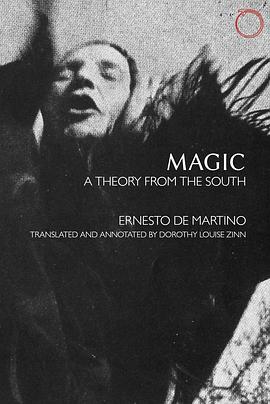
A Theory from the South
Sud e Magia
Ernesto de Martino Dorothy Zinn
Sinossi
Though his work was little known outside Italian intellectual circles for most of the twentieth century, anthropologist and historian of religions Ernesto de Martino is now recognized as one of the most original thinkers in the field. This book is testament to de Martino’s innovation and engagement with Hegelian historicism and phenomenology—a work of ethnographic theory way ahead of its time.
This new translation of Sud e Magia, his 1959 study of ceremonial magic and witchcraft in southern Italy, shows how De Martino is not interested in the question of whether magic is rational or irrational but rather in why it came to be perceived as a problem of knowledge in the first place. Setting his exploration within his wider, pathbreaking theorization of ritual, as well as in the context of his politically sensitive analysis of the global south’s historical encounters with Western science, he presents the development of magic and ritual in Enlightenment Naples as a paradigmatic example of the complex dynamics between dominant and subaltern cultures. Far ahead of its time, Magic is still relevant as anthropologists continue to wrestle with modernity’s relationship with magical thinking.
https://haubooks.org/magic-a-theory-from-the-south/
contenuti
Front Matter
Translator’s Note
by Dorothy Louise Zinn
Preface
Part One: Lucanian Magic
Chapter 1: Binding
Chapter 2: Binding and eros
Chapter 3: The magical representation of illness
Chapter 4: Childhood and binding
Chapter 5: Binding and mother’s milk
Chapter 6: Storms
Chapter 7: Magical life in Albano
Part Two: Magic, Catholicism, and High Culture
Chapter 8: The crisis of presence and magical protection
Chapter 9: The horizon of the crisis
Chapter 10: De-historifying the negative
Chapter 11: Lucanian magic and magic in general
Chapter 12: Lucanian magic and Southern Italian Catholicism
Chapter 13: Magic and the Neapolitan Enlightenment: The phenomenon of jettatura
Chapter 14: Romantic sensibility, Protestant polemic, and jettatura
Chapter 15: The Kingdom of Naples and jettatura
Epilogue
Appendix: On Apulian tarantism
References