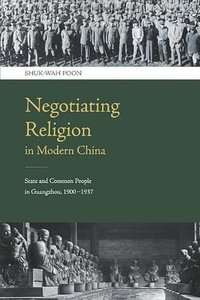
Negotiating Religion in Modern China
Douban
Shuk-wah Poon
Overview
Negotiating Religion in Modern China traces the history of the Chinese state's relationship with religion from 1900 to 1937. The revolutionary regime condemned religious practice in the early twentieth century, suppressing "superstitious" belief in favor of a secular, more enlightened society. Drawing on newspapers and unpublished official documents, this book focuses on the case of Guangzhou, largely because of the city's sustained involvement in the revolutionary quest for a "new" China. The author pays particular attention to the implementation of policy and citizens' attempts at adaptation and resistance.
書評
"This is the first in-depth local history of the encounter between secular modernity and Chinese religion. It tells a compelling story of China-wide processes (destruction, reinventions of tradition), but even more importantly, of local Cantonese negotiations that gave full meaning to such processes."
── Vincent Goossaert, CNRS (France),
author of The Taoists of Peking
"Based on a wealth of original data contained in newspapers, government publications, and archival sources, Poon convincingly demonstrates that urban religion became a vital node of contestation, negotiation, and mutual adaptation, the repercussions of which continue to shape Chinese religions today."
── Paul R. Katz, Research Fellow,
Institute of Modern History, Academia Sinica
"A fascinating, carefully researched account of how even in so modern a place as Guangzhou (or Canton), the "cradle of revolution," popular religion and its many faceless adherents managed to a surprising degree to resist the secularizing demands of the modernist state. A must-read for political and social historians of late-Qing and Republican China."
── Edward Rhoads, Professor Emeritus,
The University of Texas at Austin