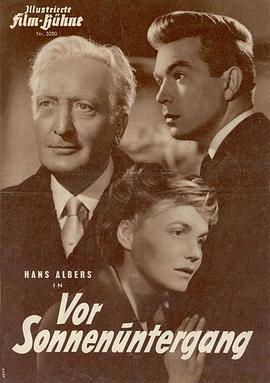
Vor Sonnenuntergang
Sinossi
This forgotten gem once won the Golden Globe as best foreign film of the year. It is the second cinematic adaption of Gerhard Hauptmann's naturalistic drama "Vor Sonnenuntergang" (1931) not to be confused with his more important play "Vor Sonnenaufgang" (still lacking cinematic treatment). (The first adaption was Veit Harlan's "Der Herrscher" from 1937 which, unfortunately, had changed the original ending to fit the ideology of the Nazis.)
Hans Albers plays the 70 years old company owner Clausen who after a disagreement with the way Klamroth (Martin Held), his son in law, is running his companies now is called an "old man" and asked to finally "step back". However, after meeting the young girl Inken he finds a new meaning of life and decides to marry her much to the disapproval both of his family and company members who will soon try to get him into an asylum.
Hans Alber's performance is heartbreaking from the start until the end and it is clearly one of his best serious performances ever. Annemarie Düringer as Inken could be better but still does a good job especially during her first dialog sequence. Equally good is Claus Biederstaedt as the seemingly "spoiled sun" who in the end turns out to be his father's only loyal supporter.
The best thing about the film are probably Erich Schellow (the Macheath from Lotte Lenya's "Threepenny opera"-production), Wolfgang "Dr. Mabuse" Preiss and, most of all: the incomparable Martin Held. Although the original play is set in the early thirties, they fully succeed in portraying the darker side and the "efficient" economic coldness of Western Germany in the 50ies, an era which by now has become known as the German "Wirtschaftswunder" (the "miracle of economy"). Arthur Miller's "Death of a Salesman" from 1949 covers some of the same issues. What isn't needed any longer is thrown away things, people and most of all: a disagreeable past (which is perhaps the only issue that falls surprisingly flat in this otherwise brilliant German after-war-film).
If this film is almost forgotten today, it is perhaps because the cinematography is "adequate" rather than "excellent". The original music is good and adds a lot of atmosphere. However, direction and cinematography, though brilliant sometimes, too often convey the feeling of filmed theater.