Nicholas Thomas — Author (9)
Possessions [Book] Douban
author: Nicholas Thomas publishing house: Thames & Hudson 1999 - 5
Tribal art has been one of the great inspirations of 20th-century Western art. Europeans such as Picasso, Matisse, Ernst and Brancusi created their own responses to masks, sculpture and other forms of African, Oceanic and American art. But is this a cross-cultural discovery to be celebrated, or just one more example of Western colonial appropriation? This work seeks to prove that both viewpoints are too simplistic. It focuses on the distinctive situation of the settler society - countries such as Australia and New Zealand in which large numbers of Europeans made their home, displacing but never entirely eclipsing native peoples. Settler artists and designers have drawn on indigenous motifs and styles to create art. Yet powerful indigenous art traditions have also been used to assert the presence of native peoples and their prior claim to sovereignty. Cultural exchange proves to be a two-way process, and an unpredictable one: much contemporary indigenous art draws on modern Western art, while affirming ancestral values and rejecting the European appropriation of tribal culture.
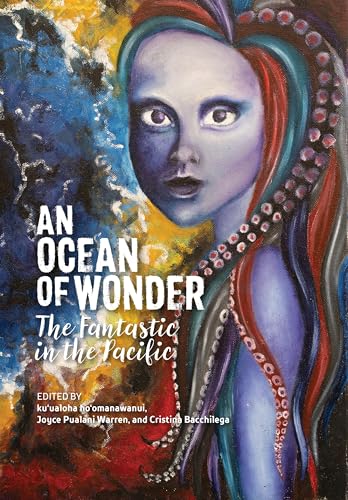
An Ocean of Wonder: The Fantastic in the Pacific [Book] Goodreads
author: Māhealani Ahia / Michael Lujan Bevacqua publishing house: University of Hawaii Press 2024 - 4
An Ocean of The Fantastic in the Pacific brings together fifty writers and artists from across Moananuiākea working in myriad genres across media, ranging from oral narratives and traditional wonder tales to creative writing as well as visual artwork and scholarly essays. Collectively, this anthology features the fantastic as present-day Indigenous Pacific world-building that looks to the past in creating alternative futures, and in so doing reimagines relationships between peoples, environments, deities, nonhuman relatives, history, dreams, and storytelling.

Wonder is activated by curiosity, humility in the face of mystery, and engagement with possibilities. We see wonder and the fantastic as general modes of expression that arenot confined to realism. As such, the fantastic encompasses fantasy, science fiction, magic realism, fabulation, horror, fairy tale, utopia, dystopia, and speculative fiction. We include Black, feminist, and queer futurisms, Indigenous wonderworks, Hawaiian moʻolelo kamahaʻo and moʻolelo āiwaiwa, Sāmoan fāgogo, and other non-mimetic genres from specific cultures, because we recognize that their refusal to adopt restrictive Euro-American definitions of reality is whatinspires and enables the fantastic to flourish.

As artistic, intellectual, and culturally based expressions that encode and embody Indigenous knowledge, the multimodal moʻolelo in this collection upend monolithic, often exoticizing, and demeaning stereotypes of the Pacific and situate themselves in conversation with critical understandings of the global fantastic, Indigenous futurities, social justice, and decolonial and activist storytelling.In this collection, Oceanic ideas and images surround and connect to Hawaiʻi, which is for the three coeditors, a piko (center); at the same time, navigating both juxtaposition and association, the collection seeks to articulate pilina (relationships) across genres, locations, time, and media and to celebrate the multiplicity and relationality of the fantastic in Oceania.
Colonialism's Culture [Book] Douban
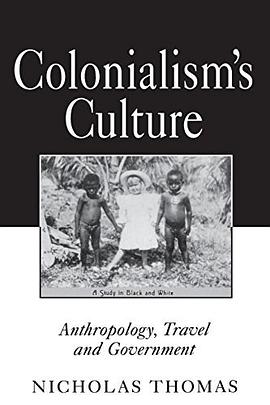
author: Nicholas Thomas publishing house: Princeton University Press 1994 - 5
In a wide-ranging account of the development of ideas about human difference, Nicholas Thomas challenges reigning theories that portray colonialism as monolithic in character, purpose, and efficacy throughout the world. Taking issue with such writers as Edward Said, Homi Bhabha, and Gayatri Spivak, Thomas describes colonialism not so much as a discourse but a project - a project in which the interactions among colonizing and colonized people are far more variable and reveal greater ambivalence than generally imagined. In addition to his review of current literature in cultural studies, the author provides extended reflections on photographs, colonial novels, exhibits of indigenous art, ethnographic films, and recent Hollywood films in order to reveal how deep and pervasive is colonialism's culture for colonizer and colonized. Thomas proposes that historicized, ethnographic explorations of the colonial experience are the most fruitful approaches to understanding colonialism's continued effects. He draws on travel, anthropology, and government as vehicles that gave nineteenth- and early twentieth-century Europeans exposure to colonized populations and provided a language through which to discuss them. The author reveals colonialism to be a complex ongoing cultural process - one in which dominated populations are represented in ways that play upon and legitimize racial and cultural differences. A provocative book for specialists, "Colonialism's Culture" can also serve as a stimulating introduction for students across the social sciences and humanities interested in this multifaceted field of inquiry.
In Oceania: Visions, Artifacts, Histories [Book] Goodreads
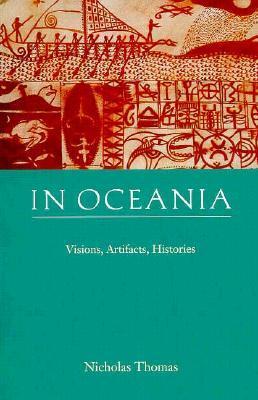
author: Nicholas Thomas publishing house: Duke University Press Books 1997 - 10
In this collection of essays, Nicholas Thomas, a leading theorist of historical anthropology, explores the historicization of cultural encounters in the region referred to as Oceania. Basing his claims on wide-ranging historical and ethnographic research and building on his celebrated studies of exchange and colonialism in the Pacific, Thomas describes how outsiders and islanders alike have constructed indigenous cultures over the last two hundred years.
In Oceania documents and analyzes the "rhetorical artifacts" of explorers, missionaries, fiction and travel writers, and the people of the Pacific themselves to illustrate how Oceanic identities have been represented over time. Not content with conventional methods of anthropology or history, Thomas draws on postcolonial theory and literary analysis in extraordinarily wide-ranging analyses of texts, visual images, and historical processes. He demonstrates how cultures of the Pacific Islands have dealt with colonialist ventures, modernity, and the debate about the recuperation of histories and traditions. The picture Thomas paints of Oceania, however, is not one of a group of societies stripped of meaning, but one that shows how the interactions between indigenous cultures and European influences have created entirely new identities.
Voyagers [Book] Google Books
author: Nicholas Thomas publishing house: Basic Books 2021
An award-winning scholar explores the sixty-thousand-year history of the Pacific islands in this dazzling, deeply researched account. One of the Best Books of 2021 -- Wall Street Journal The islands of Polynesia, Melanesia, and Micronesia stretch across a huge expanse of ocean and encompass a multitude of different peoples. Starting with Captain James Cook, the earliest European explorers to visit the Pacific were astounded and perplexed to find populations thriving thousands of miles from continents. Who were these people? From where did they come? And how were they able to reach islands dispersed over such vast tracts of ocean? In Voyagers, the distinguished anthropologist Nicholas Thomas charts the course of the seaborne migrations that populated the islands between Asia and the Americas from late prehistory onward. Drawing on the latest research, including insights gained from genetics, linguistics, and archaeology, Thomas provides a dazzling account of these long-distance migrations, the seagoing technologies that enabled them, and the societies they left in their wake.
Entangled Objects [Book] Douban
author: Nicholas Thomas publishing house: Harvard University Press 1991 - 10
Drawing on his work on contemporary postcolonial Pacific societies, Nicholas Thomas takes up three issues central to anthropology: the cultural and political dynamics of colonial encounters, the nature of Western and non-Western transactions (such as the gift and the commodity), and the significance of material objects in social life. Along the way, he raises doubts about any simple "us / them" dichotomy between Westerners and Pacific Islanders, challenging the preoccupation of anthropology with cultural difference by stressing the shared history of colonial entanglement. Thomas integrates general issues into a historical discussion of the uses Pacific Islanders and Europeans have made of each other's material artifacts. He explores how 19th-century and 20th-century islanders, and visitors from the time of the Cook voyages up to the 1990s have fashioned identities for themselves and each other by appropriating and exchanging goods. Previous writers have explored museums and the tribal art market, but this book concentrates on the distinct interests of European collectors and the islanders. It should be of interest to all those working in the fields of cultural studies, from history
Islanders [Book] Douban
author: Nicholas Thomas publishing house: Yale University Press 2012 - 1
This compelling book explores the lived experience of empire in the Pacific, the last region to be contacted and colonized by Europeans following the great voyages of Captain Cook. Unlike conventional accounts that emphasize confrontation and the destruction of indigenous cultures, "Islanders" reveals that there was gain as well as loss, survival as well as suffering, and invention as well as exploitation. Empowered by imaginative research in obscure archives and collections, Thomas rediscovers a rich and surprising history of encounters, not only between Islanders and Europeans, but among Islanders, brought together in new ways by explorers, missionaries and colonists. He tells the story of the making of empire, not through an impersonal survey, but through vivid stories of the lives of men and women - some visionary, some vicious, and some just eccentric - and through sensuous evocation of seascapes and landscapes of the Pacific. A fascinating re-creation of an Oceanic world, "Islanders" offers a new paradigm, not only for histories of the Pacific, but for understandings of cultural contact everywhere.
Anthropological Theory Today [Book] Douban
author: James G. Carrier & Daniel Miller / Aihwa Ong publishing house: Blackwell Publishers 2000 - 1
This important book makes a bold statement about the nature and value of anthropological theory at the beginning of the 21st century.