other title:
奎马达政变
/
Burn!
…
In the 1830's, the island of Quemada in the Antilles is a Portuguese colony - that is, until an English agent provocateur arrives and inspires the black slaves to rise and expel the colonial authorities. However, as is always the way with revolutions, a group of middle-class power brokers seizes political control and the people's aspirations are betrayed.
Ten years pass, and the sugar industry now requires peace and stability on Quemada. The continuing guerilla campaign by the dispossessed blacks is harming profits. The very same English adventurer is once more despatched to the island, this time to hunt down and eradicate the revolutionaries he created.
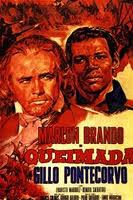
Marlon Brando plays Sir William Walker in his best Fletcher Christian English accent and a blonde wig with a life of its own. His is a thoughtful performance, putting across the complexity of the man, a character who is undoubtedly cynical and unscrupulous, but who is also an emotional man and something of a political philosopher. He is certainly effective at what he does.
The direction of Gillo Pontecorvo is somewhat erratic at times. There are points where the narrative is confused, and the gold robbery which drives the plot somehow got left on the cutting-room floor. Jose Dolores' rise to power is the most significant event in the story, but we see nothing of it. During the voodoo carnival, two of the participants are wearing 20th-century soccer shorts. The film's central pivot, the passage of ten years between Walker's two visits to the island, is handled very sketchily by means of a few incongruous London scenes and a voice-over narration.
But there are good things, too. When Santiago's widow hauls her husband's body away, the masonry of the fort stands as a silent metaphor of colonial power - harsh, overbearing and sterile. Brando has some fine speeches, musing on the nature of political legitimism. The fire scenes are visually arresting (though it would have sufficed to have two or three guerillas being shot as they emerged from the burning sugar cane: seven or eight is labouring the point), and Walker is positively luminous against the tortured black shapes of the charred forest, showing in symbolic form that this man thrives on the suffering of the blacks, and that destruction is his natural element.