Ronald Inglehart — Author (3)

Book

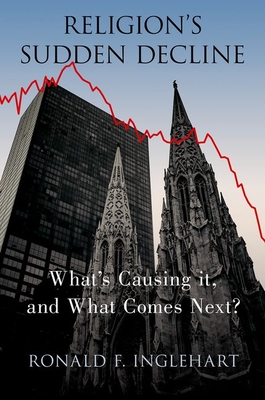
Religion's Sudden Decline: What's Causing it, and What Comes Next?
Goodreads
Ronald Inglehart publishing house: Oxford University Press 2021 - 1
Mass attachment to religion is rapidly declining in most of the world; Why, and What comes next? The world is becoming less religious. Since 2007, there has been a pervasive decline in religious belief and most of the world's people now say that God is less important in their lives than they said He was in the quarter century before 2007. The American public showed the most dramatic shift of all. The United States, which for many years stood as a highly religious outlier among the world's high-income countries, now ranks as the 12th least religious country for which data are available. Many factors contributed to this dramatic worldwide shift, but as Inglehart shows, certain ones stand out. For centuries, virtually all major religions encouraged women to stay home and produce as many children as possible; and they sternly discouraged divorce, abortion, homosexuality, contraception, and any other form of sexual behavior not linked with reproduction. These norms were necessary for societies to survive when facing high infant mortality and low life societies that didn't instill them tended to die out. Recent technological advances have greatly increased life expectancy and cut infant mortality to a tiny fraction of its historic levels, making these norms no longer necessary for societal survival. These norms require repressing strong natural urges, but, since they present traditional norms as absolute values, most religions strongly resist change. The resulting tension, together with the fact that rising existential security has made people less dependent on religion, opened the way for an exodus from religion. Utilizing a massive global data base, Inglehart analyzes the conditions under which religiosity collapses, and explores its implications for the future.
Book

Modernization and Postmodernization
Goodreads
Ronald Inglehart publishing house: Princeton University Press 1997 - 5
Ronald Inglehart argues that economic development, cultural change, and political change go together in coherent and even, to some extent, predictable patterns. This is a controversial claim. It implies that some trajectories of socioeconomic change are more likely than others--and consequently that certain changes are foreseeable. Once a society has embarked on industrialization, for example, a whole syndrome of related changes, from mass mobilization to diminishing differences in gender roles, is likely to appear. These changes in worldviews seem to reflect changes in the economic and political environment, but they take place with a generational time lag and have considerable autonomy and momentum of their own. But industrialization is not the end of history. Advanced industrial society leads to a basic shift in values, de-emphasizing the instrumental rationality that characterized industrial society. Postmodern values then bring new societal changes, including democratic political institutions and the decline of state socialist regimes. To demonstrate the powerful links between belief systems and political and socioeconomic variables, this book draws on a unique database, the World Values Surveys. This database covers a broader range than ever before available for looking at the impact of mass publics on political and social life. It provides information from societies representing 70 percent of the world's population--from societies with per capita incomes as low as $300 per year to those with per capita incomes one hundred times greater and from long-established democracies with market economies to authoritarian states.

Book

Modernization, Cultural Change, and Democracy
Douban Goodreads
Ronald Inglehart / Christian Welzel publishing house: 劍橋大學出版社 2005 - 10 other title: Modernization, Cultural Change, and Democracy: The Human Development Sequence
Review "Modernization, Cultural Change, and Democracy is the crowning achievement of three decades of research on the origins, evolution, and consequences of human values. Bold in its theorizing, pathbreaking in its methods, breathtaking in its empirical scope, and stunning in its findings, this book is one of the most important social science works ever produced on the relationship between values, development, and political regimes. Inglehart and Welzel make a compelling case for viewing development as the expansion of human autonomy and choice, and for political freedom and democracy as the consequence of economic development and cultural change. Anyone who thinks modernization theory is dead will have to grapple with the powerful logic of their evidence and argument." -Larry Diamond, Stanford University "This book is a landmark in the study of political culture and democratization. It will polarize opinion, provoking both strong acclaim and fierce critique. For this work presents powerful evidence contradicting several major schools of thought in the social sciences. It will be debated and cited now, and in years to come." -Hans-Dieter Klingemann, Fondation Nationale des Sciences Politiques, Paris "Inglehart and Welzel's book is a tour de force. Its comprehensive theory of how social modernization shapes human development makes a major contribution to our understanding of political development. This theory is tested by a rich analysis of peopleas opinions and values from all four waves of the World Values Survey--an unprecedented social science resource that covers 85 percent of the world's population. They conclude that social modernization shapes the human condition in predictable ways, and that the cultural consequences of modernization are a major force driving democratization. Culture matters--in nurturing the conditions for democracy to develop and in shaping the workings of the democratic process." -Russell J. Dalton, University of California, Irvine "Good books raise important questions after they have answered other important ones. Readers interested in political culture research and its contribution to understanding democratization processes will profit greatly from this book and, in addition, they will become acquainted with a professionally managed large-scale survey research project that offers many opportunities for further research." -Franz Urban Pappi, Universitat Mannheim, American Journal of Sociology Product Description This book demonstrates that people's basic values and beliefs are changing, in ways that affect their political, sexual, economic, and religious behavior. These changes are roughly predictable because they can be interpreted on the basis of a revised version of modernization theory presented here. Drawing on a massive body of evidence from societies containing 85% of the world's population, the authors demonstrate that modernization is a process of human development, in which economic development triggers cultural changes that make individual autonomy, gender equality, and democracy increasingly likely.