Yang Ju-nam — Director (3)

Movie

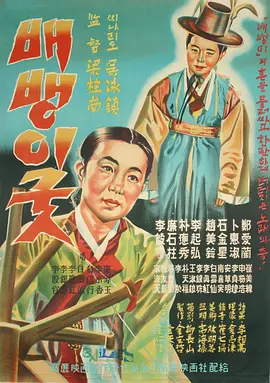
Exorcism of Bae-Baeng-Yi (1957)
배뱅이굿 Douban
梁柱南 actor: 赵美铃 / 石金星 …
other title: 배뱅이굿 / 裴氏巫祭
Se-wol lives in front, Ne-wol in the back, and Baebaeng-i in the middle. Baebaeng-i dies of lovesickness for a monk who visits houses begging for alms. As a passing-by rogue gets the information at a bar, he goes to Baebaeng-i's house and recommends that his family perform a gut (shamanic ritual) in order to solace Baebaeng-i's poor spirit. The rogue plays the skillful male shaman and leaves with a lot of money paid for his role.

Movie

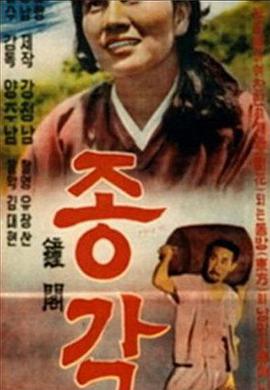
The Bell Tower (1958)
종각 Douban
梁柱南 actor: Moon Jeong-Suk,Heo Jang-Kang,Maeng Man-Shik,Jang Min-Ho
other title: 钟阁 / 종각
Synopsis Bellmaker Seok-seung (Heo Jang-kang), whose most famous handiwork is the legendary bell of Goryeong Temple, is living out his old age at a temple with a young woman named Young-sil (Moon Jeong-suk) as his neighbor. One day, Young-sil hears about Seok-seung's past. The grandson of a famous bellmaker, Seok-seung works as a servant. He promises his lover Ok-bun (Moon Jeong-suk) that he will make a bell with the most beautiful sound in the world, and when Ok-bun suddenly dies, he sets about fulfilling his promise to her. He studies bellmaking for over a decade. Wandering the country following his teacher's death, Seok-seung meets a widow (Moon Jeong-suk) and settles down with her. His grandfather had committed suicide after losing to a rival bellmaker; Seok-seung steals the bell made by the rival artisan along with his grandfather's bell and runs off with them. While he is endeavoring to create the world's finest bell, his wife dies in childbirth. Continuing his pursuit of the perfect bell, Seok-seung finally succeeds in forging the most beautiful-sounding bell in the world by melting his grandfather's bell and the rival artisan's bell together, but he loses his daughter. Meanwhile, as she listens to Seok-seung's tale, Young-sil begins to wonder if he is actually her long-lost father. Growing up as an orphan, she remembers hearing that her father was also a bellmaker. At the time, Japan is fighting in the Second World War and commandeering all the iron in Korea for its military campaign. The bell at Goryeong Temple also comes under threat of seizure. Fearing for its fate, Seok-seung tries to remove the bell and hide it, but falls down a cliff in the attempt and draws his last breath in Young-sil's arms. Notes Alternating between present and past through Seok-seung's and Young-sil's flashbacks, The Bell Tower relies on voice-over narration by each character to tell the story of their lives. This device gives the audience the impression of listening to an old tale. The Bell Tower may well be the first major Korean film to employ a structure that combines voice-over narration with flashback sequences. As revealed in film reviews of the time, The Bell Tower affords glimpses of the considerable effort the filmmakers put into, instilling something "uniquely Korean" in its content and imagery. It is an impressive movie that unostentatiously depicts the premodern artisan's stubborn passion for his work and the realizations and regrets brought about by time. The performances of Heo Jang-kang and Moon Jeong-suk, the latter delivering an impassioned turn in three different roles, also make The Bell Tower a standout. It is the first Korean film to be made for submission to foreign film festivals.

Movie

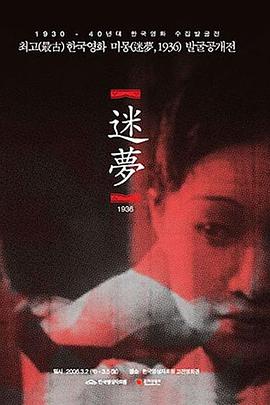
Death's Lullaby (1936)
미몽 Douban
梁柱南 actor: Cho Taek-wo
other title: 迷梦 / 미몽 …
Middle-class housewife Ae-soon (Moon Yae-bong) is excessively vain and neglectful of her duties as a homemaker. Unable to tolerate her any longer, Ae-soon's husband (Lee Keum-ryong) kicks her out, and she leaves him and their daughter Jeong-hee (Yoo Sun-ok) to take up with her lover in a hotel. One day, she finds out that her lover is not a wealthy bigshot after all, but a poor lodger and a criminal to boot. She reports him to the police for a robbery he has committed, and decides to go to Busan after handing him over to the authorities. Speeding in order to catch her train, she accidentally runs over her own daughter. Jeong-hee is rushed to the hospital, where she safely regains consciousness, but Ae-soon is wracked with guilt and resorts to suicide. "The oldest film in existence, and a valuable window into 1930s film grammar, as well as into discourses on New Women and modernity during the Japanese colonial era" Sweet Dreamwas discovered in China by the Korean Film Archive (KOFA) in 2006. As of 2006, it is the oldest Korean film for which the film stock still remains. Director Yang Ju-nam's first film and the sixth "talking picture" from Kyeong Sung Studio, Sweet Dreamis an invaluable standard for examining the film grammar and technical progress of 1930s cinema. The movie's implausible two-dimensional characters, abrupt plot progression, and awkward camera angles and editing indicate that a stable film grammar had yet to be established at this point. Nonetheless, such devices as the aggressive sound montage, the insert shot of the birdcage, and the shot in which Ae-soon, angry at her husband, unsettles the vanity mirror that shows the reflection of her husband's face demonstrate the director's basic awareness of cinematic forms. The movie was released sometime after Henrik Ibsen's A Doll's Housedebuted in Japanese-occupied Korea, when debates about "New Women" were particularly rife. As such, it reflects popular attitudes regarding New Women at the time. Ae-soon's unconvincing insistence on buying the most expensive items at a department store and the sudden castigation she is subjected to for the purpose of emphasizing maternal responsibility appear to be forced moves that were introduced into the unfolding narrative in an attempt to reductively portray the controversial New Woman as licentious, vain, and immoral. Other notable features of the film are the inclusion of modern elements such as the scenery of Seoul at the time and a chase scene between a car and a train. The movie also provides an opportunity to glimpse Moon Yae-bong, who was the most popular actress of the Japanese colonial period and the greatest actress in North Korea, during her debut years.