other title:
太阳
/
Sole!
…
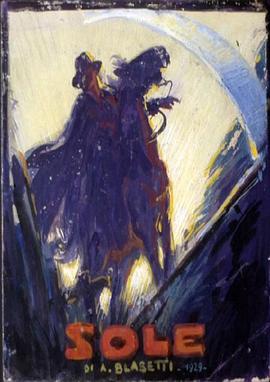
Sole is the first film by the great Alessandro Blasetti and bears a complex relationship to the reclamation of the Pontine Marshes, a seminal event in Fascist political history. Sole is also an important document in Italian film history. Its use of non-professional actors and location shooting began the movement away from studio spectacle and historical costume epic toward Italian film realism. Along with Blasetti's later film 1860 (1934), Sole includes many of the cinematic and humanistic traits of neorealism and underscores Blasetti's role as one of its progenitors.
Background
The film's subject is the massive, highly visible bonifica integrale ("integrated reclamation") project undertaken in 1929 by Mussolini to drain the Pontine marshes, located on the Appian Way some 30 miles southeast of Rome, between Anzio and Terracina. The marshes were a malarial swamp populated by a culturally rich but politically powerless native people, and therefore regarded as ripe for reclamation.
The project aimed to replace the marshes with productive farmland and rural housing, and was a Fascist poster for public works and the "rural vocation of the Italian people". Settlers were provided with a standarized two-storey farmhouse of blue stucco with tiled roof, an oven, a plough, agricultural tools, a stable, some cows and several hectares of land. Mussolini was regularly photographed shirtless with workers and farmers, tool in hand, for inclusion in propaganda newsreels.
Mussolini spearheaded the legislation, thereafter known as "Mussolini's Law". Work began in 1929, the year that Sole was made, and involved as many as 100,000 workers. Workers were paid poorly, interned in barbed wire camps with minimal care and sanitation, and malaria was rampant. Although Fascist agrarian ideals would have transformed the natives from primitive swamp dwellers to productive farmers, in fact, due to their unreliable politics, the natives were evicted and the five planned towns were populated with reliable supporters from strongly Fascist Northern Italy.
Ironically, Anzio at the north end of the filled marshes later served as the Allied beachhead for a planned flank attack on German forces and a march on the "Open City" of Rome. To impede this, Germans turned off the drainage pumps to reflood the marsh, hoping to create a malarial net for the invaders. As a result, Allied and German soldiers fought malaria as well as each other, agriculture was devastated, houses were commandeered or destroyed, and the population was driven out. The area was physically devastated, undoing Il Duce's accomplishments.
The film
Sole has a complex relation to the Fascist project it documents. Outwardly it's a paeon to Fascist engineering and values such as the will toward progress, rural agrarian development, cultural homogenization and a positivistic spin on the "eternal conflict between civilization and regression". Mussolini reportedly admired the film in a private screening before its release. But the film resides ambiguously between Fascist values and a neo-realist appreciation for local culture and sympathy for the displaced swamp people and reclamation workers. Like 1860, Sole has non-professional actors, location shooting and a populist point of view, traits that were heralded 20 years later in La Terra Trema as the foundation of neorealism.
The film offered here is the only known fragment – the first reel containing 265 m (about 9 minutes) of the original 76 mintues. The original negative was destroyed by the Nazis during the Roman occupation of 1943-1944.
Sources:
Images:
(filmnutz)