The First Anthropological Study in English about Mongolia after 1990
Book · Review
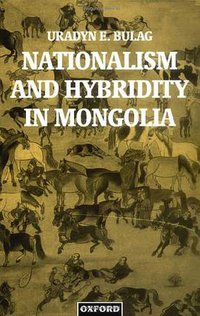
Nationalism and Hybridity in MongoliaThis book is written by Dr. Uradyn E. Bulag, a Reader of the Department of Social Anthropology, University of Cambridge. Bulag is from Ordos region of Inner Mongolia and receives his doctoral degree from University of Cambridge in 1993. This is his first book, adopted from his doctoral thesis.
In the foreword contributed by Dr. Caroline Humphrey, she has addressed the significance and contribution of this book. At the beginning, she mentioned the obstacles met by anthropologists for decade to conduct fieldworks in Mongolia, including Mongolian People’s Republic (MPR), Buryatia in the Soviet Union, and Inner Mongolia in People’s Republic of China. First, no one was allowed to go to the countryside and was supervised by the government of Mongolia when shortly stayed in major cities. Furthermore, the communist governments of ruling over those Mongolian territories intentionally had concealed the tragedies which happened in those areas, such as the elimination of Buddhist institutions, purge of enemies of state, and the persecution of certain ethnic minorities. On the one hand, Bulag is one of the first anthropologists who conducted his fieldwork in the early 1990s, a decisive moment for Mongolia. Therefore, his work is groundbreaking. On the other hand, Bulag’s identity, as he says, is not a real Mongol, but a Chinese hybrid (erliiz, эрлийз in Modern Mongolian, from Erleizi 二類子in Chinese) for the Halh Mongols. This interstitial identity, in Homi Bhabha’s sense, offers him an extraordinary angle to observe his fellow people.
In this book, Bulag’s main argument is that the Mongols are facing a choice between Halh-centric nationalism, a purist, racialized nationalism and Pan-Mongolism, a more open, adaptive nationalism accepting of diversity, hybridity, and multi-culturalism. Mongolia’s nationalism is based on the division of purity and danger and Mongolia’s paranoid fear of China. The author suggests a mutual respect and understanding between pan-Mongolists and Halh-centrists.
In the first chapter, the author sets the theme of the book and gives his personal background. The theme of this book is the Halh Mongols’ attitudes toward those no-Halh Mongols.
For Inner Mongols, Mongolia is considered as Shangri-La where the Mongol culture is flourishing and Mongols has a delightful life and shares an equal statehood as any nation-state in the world. That is because Inner Mongols was suffered by genocidal oppression of the Cultural Revolution, a long-term segregation from other Mongol communities abroad since the mid-1960s. Therefore, the term “diaspora” was adopted by Inner Mongols. However, for the Mongols in Mongolia, they are pure Mongolians, and those Mongols outside of Mongolia are impure. The root of Mongols’ exclusive purity is Mongolia’s paranoid fear of China.
The author argues that there exists a kind of greater Mongolia sentiment. What united the author and the Mongols in Mongolia was a common culture, a ‘supra-Mongol’ culture that had its roots in pastoralism and history that went beyond tribal and national boundaries.
In Chapter 2, Bulag illustrates the creation of ethnicity and nationalism in modern Mongolia. Nationalism tends to create homogeneous cultures. Ethnicity, not as Hobsbawn argues, is a political phenomenon.
The author argues that there was a Mongolian ethnie, pre-modern nation in Smith’s sense. There were also two types of Mongolian nationalism: Inclusive and exclusive. Inclusive Mongolian nationalism (Greater Mongolia) was based on 13th-century Mongolian state built by Chinggis Khan; the exclusive Mongolian nationalism (Halh-center), established on a 16th-century tribal division which later strengthened by the Manchu empire. The author further contends that the nature of real socialist organization is intrinsic in creating nationalism and ‘ethnic revival.’
The creation of ethnic consciousness and the manifestation of ethnicity are intrinsic in the process of the socialist nation-building. The issue of nationality in Mongolia was not raised until 1990. The identification of nationalities had become an issue in Mongolia.
Socialist Mongolian nation is a new biological and cultural unity, i.e. Halh. The communists create class and ethnicity in Mongolia.
The author mentions that the discourse of majority and minority in Mongolia, that is, to be Halh means to be a better Mongol and a better human being. By establishing hierarchical ethnic status, Mongolia has unwittingly (?!) created criteria to judge who is more Mongol, who is less. This process is called ethnic process by the author.
According to Bulag, the components of new Mongolian national identity are 1) Destruction of Buddhism; 2) Pan-Mongolism was regarding as invasion of Japan imperialist; 3) Soviet-Mongol brotherhood. The social condition for waging nationalist revolution was that the Mongols were a people who had a common culture.
As to the elements of the common Mongol culture, Bulag gives us three main characteristics: 1) one literary language; 2) pastoral mode of production; 3) Buddhism (That is why the 1911 restoration was led by the lamas first).
Bulag’s criticism to Gellner’s theory of nationalism is that not the division of labor that creates cohesion, but the unification of the lay and the sacred. Mongolness is embedded in the patterns of pastoral mode of production and Buddhism. In pre-Modern Mongolia, even the nobles are familiar to the nomadic life-style and anyone can rise in the monastery.
In socialist Mongolia, Internationalism and patriotism, sponsored by Tsedenbal and Soviet Union and became the political orthodoxy, means the integration of Mongolia with the USSR and playing the Mongolia’s role in the internationalist division of labor. In order to follow this tenet, socialist Mongolia has to raise a campaign with three newly appearing phenomena: 1) nationalism or chauvinism (ündesrheh üzel) ; 2) localism; (nutgarah üzel); 3) ethnic nationalism (yasharhah üzel). The main purpose of this struggle is to achieve “integration of Mongolia with the Soviet Union, mutual accommodation of people of different regions in Mongolia, assimilation of diverse Mongolian ‘ethnic groups’ into the Halh nation.”
Here, Bulag also mentions the division of the urban and the rural in Mongolia. He argues that the countryside becomes the genuine source of Mongol culture and wealth.
To Bulag, Greater Mongolia sentiment is not pan-Mongolism because it is a kind of non-political greater Mongolian sentiment.
The ethno-politics in Mongolia is the topic of the 3rd chapter. In this chapter, the author analyzes the construction of the central status of Halh Mongols. Halh was considered as the representative of Eastern Mongols and Oirat the representative of West Mongolia by Halh historians. However, this theory is just a replication of Mongolian aristocratic historiography. Halh Mongol was just one of the six myriachies of the Eastern Mongols and not the central (gol) tribe. Modern Mongolia adopted the Soviet model and defines itself as a Halh-Mongol nation and that concept conflicted with other non-Halh Mongolian identities, such as Dürbets and Buryats. Those Buryats and Dürbets had been viewed as conspirator or foreign spies. As to the Kazakhs, they chose to leave Mongolia, driven by pan-Mongolism.
Chapter 4 is about the relationship between biological reproduction and Mongol nationalism. Here, the author mentions that the Mongolian elites are to tackle with the imagined problems of biological reproduction. They regards the mental retardation of Mongols has become a serious problem and would endanger the future of the Mongol nation. Therefore, the elites suggest that the archaic exogamous custom and incest taboo should be restored. The revival of the obsolete exogamous clan system and a national endogamy with the aware of purity becomes the theme of Mongolian nationalism. To the author, the Mongolian nationalist discourse implies that a nation can be seen as a human body. “If a nation is to survive, the body must be kept healthy and strong.”
In the following chapters, Bulag talks about the gendered discourse of race in Mongolia, Inner Mongols as ‘Other’ to Mongols, and the choice of national symbols in socialist and post-socialist Mongolia.
Bulag argues that the concept of Mongol Ulus is from Hamag Mongol in The Secret History of the Mongols. However, Bulag overlooks the influence of Manchu imperialist ethnic project. As to Manchu construction of Mongol identity, see Johan Elverskog, Our Great Qing: The Mongols, Buddhism and Late Imperial China (Hawai’i: University of Hawaii Press, 2006).
Taken together, the fear of being polluted by Chinese blood leads to the new emphasis on ‘blood’ and ‘genes.’ The category of erliiz (half-breed) had been a positive ideal, signifying health and strength, but it has become despicable under this new context. To Bulag, Mongolia is a gendered nation(-state). In Mongolia, men “guarantee the perpetuation of the bond by controlling the land, women, language, culture, etc. The state is the highest power enabling men to guarantee this control.”
(Jan 4, 2011)