From the Artist
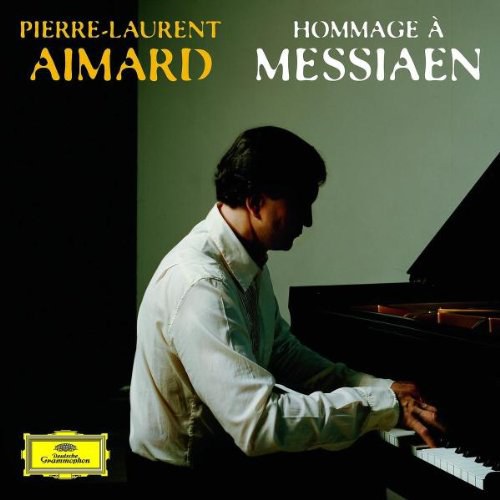
The present recording features highly contrastive aspects of Messiaen's personality. The composer was a visionary who retained his independence throughout the 20th century and invited us in the process to rethink the way in which we listen to music. As a man, he was secretive by nature, with the gentleness and modesty of some of his Préludes. He also had the capacity for marvelling at the world around him, which, together with his powers of listening, finds expression in his Catalogue d'oiseaux. And he was intellect¬ually inquisitive, a quality which, like his sense of order, is reflected in his Études de rythme. I hope that this homage in the form of a portrait will encourage others to share my love not only for this great creator of time and colour but also for this mysterious and radiant man.
Product Description
The centenary of Olivier Messiaen's birth provides an occasion for surveying his place in the landscape of musical creation. This recording, which brings together some relatively neglected pieces from his abundant output, represents both an act of homage to the composer and a reflection on the special position his works occupy in 20th-century music. In three segments, it presents compositions of three different types, each written at a difficult time in his life and emphasizing the fundamental role of the piano in his oeuvre. The Préludes are among Messiaen's earliest pieces, written in 1928-29, when he was 20 and still a student at the Paris Conservatoire. Later he described them as a "collection of successive states of mind and personal feelings". All eight were composed under the shock of the death of his mother, the poet Cécile Sauvage. She is "the dove" of "La Colombe", while the heart-rending "Cloches d'angoisse et larmes d'adieu" gives us an idea of the traumatic effect of her death on so gentle and sensitive a youth. Pieces dealing with grief and mourning are contrasted with others of great luminosity. Thus the "Chant d'extase", placed at the heart of this sombre landscape, allows us a foretaste of the luminous grace of some of the Vingt Regards sur l'Enfant Jésus. The cascading gems of "Les Sons impalpables du rêve" cast a musical spell entirely worthy of the finest works of the 1930s. Messiaen ends his cycle with "Un Reflet dans le vent", a piece that is by turns angry and lyrical. This may be a lesson in optimism on the part of a man of faith who was capable of turning to the light in the blackest of all possible circumstances (an ability also manifested in his Quatuor pour la fin du temps, written in a prisoner-of-war camp). But it could also be an expression of the hope awoken in him by the work's dedicatee, the pianist Henriette Roget, with whom he was in love. The surreal titles of some of these Préludes adumbrate texts that the composer - who had a fondness for the poetry of Paul Éluard - would later write and set to music, especially those of his song cycle Harawi. But what is most impressive about them is the world of colour they inhabit, a world both highly personal and already strongly defined. Each piece involves detailed associations between sound and colour. According to the composer, the fifth Prélude is "polymodal, superimposing an orange-blue ostinato on chordal cascades in a violet-purple mode that is invested with the timbre of a brass instrument". But it is in "Cloches d'angoisse et larmes d'adieu", the masterpiece of the cycle, that the composer most fully discloses his individual treatment of sonority. As Messiaen himself explains: "The bell-like sound combines many modes; the deep resonant tone of the bells and all their high harmonics resolve into luminous vibrations." His subtle use of resonance, inviting us to listen "inside" the bells, turned him into a prophet for generations to come, particularly the composers of spectral music. The composer's passion for nature and birdsong finally became omnipresent in the 1950s, resulting in a series of naturalist works that illustrate two of the more remarkable qualities of Messiaen as man and artist: his exceptional listening powers and his bound¬less capacity for astonishment. The precision and fidelity of his birdsong transcriptions reveal both his amazing ear and his tremendous concern for detail. But as a source of inspiration, this new-found interest also allowed him to escape from the anguish of a life overshadowed first by terrible illness and then by the death of his wife, the violinist Claire Delbos. It is interesting to see this radical move within the wider context of a period marked by other musical aesthetics and languages as well as by techniques that repre¬sented a break with the past. Messiaen made a point of keeping abreast of the work of the younger generation of avant-garde composers, and he himself made an entirely fresh start by writing whole pieces made up of completely new material having no historical point of reference: this was the birdsong that he transcribed systematically. His first "manifesto" was Réveil des oiseaux for piano and orchestra (1953), which is made up entirely of birdsong. By the end of the 1950s, this radicalism, coupled with his love of systemization, had led him to write the vast Catalogue d'oiseaux for piano solo (1956-58), from which two excerpts are included here. "La Bouscarle" (Cetti's Warbler) presents a great variety of birdcalls and suggests a miniature piece of ornithological theatre. The characterization of each call recalls how Messiaen, some years earlier, had defined the dimensions of his musical vocabulary by "individualizing" every sound in a different way. Here each bird has its own timbre, its own speed, its own distinctive musical behaviour. Although written while Messiaen was recovering from a serious illness, the piece still has a great sense of spontaneity and is bathed in light and colour. "L'Alouette Lulu" (Woodlark), conversely, is a night-piece for just two protagonists, a nocturnal poem that bewitches us with its mysterious realism. Like the other pieces that make up the Catalogue d'oiseaux, these two "moments musicaux" seduce us with their immediate freshness, total originality and incredible sonorities. But they also represent an extraordinary example of Messiaen's powers of perception. Just as we hear birds in nature without knowing which will sing and when, or for how long or where and at what distance, so we are invited here to experience the unexpected in an open acoustic space. This instance of listening with no beginning or end or any real sense of direction is related to experiments in open form and the aes¬thetics of chance that other composers actively engaged in research were undertaking at the time. The two Îles de feu both date from 1950 and are studies in rhythm of phenomenal energy. A lover of exoticism, Messiaen dedicated them to Papua, "in other words, all the Papuans", some of whose rites he found seductively attractive by dint of their violence. In the present pieces, this violence finds expression in wild dances, hammered rhythms and a furious hand-to-hand battle with the instrument. In Île de feu II, passages in this vein alternate with more distanced moments of rhythmic speculation in which each sound is affected by a different duration and also by a different "profile". These passages reflect the research into rhythm that Messiaen undertook at the end of the 1940s, when his reflections on time led him to create a new vocabulary and to organize his new time values in an altogether revolutionary way. The end of the piece borrows from another type of music found elsewhere in the world, using what Messiaen himself described as "the rules derived from the `jātis', classical Hindu melodies of the Vedic period". The two Îles de feu form a dazzling pair of works attesting to Messiaen's powerful interest in neo-primitivism - one thinks of his fascination with The Rite of Spring and his respect for André Jolivet's Mana. Their very particular virtuosity and gestural language certainly owe a great deal to the pianism of Yvonne Loriod, the composer's second wife, who following the war became his preferred interpreter and a source of inspiration. The effulgence of their sonorities, their savage energy and their rhythmic boldness make an impressive impact.