Hamelin
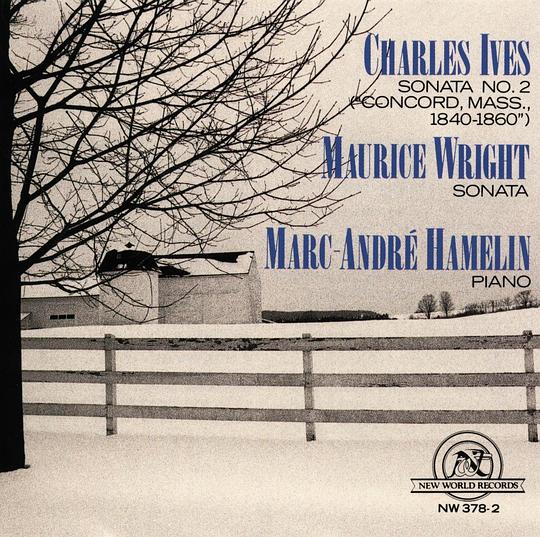
Charles Ives: Sonata No.2; Maurice Wright: Sonata Douban
Marc-Andre Hamelin genre: Classical
release date 1992-12-08 publisher: New Wolrd Records
查理·艾夫斯(Charles Ives 1874-1954)是美国作曲家查尔斯·艾夫斯在1874年10月20日出生于康涅狄格州(Connecticut)的丹伯里(Danbury)城。艾夫斯是在十三岁时开始尝试作曲的,而当他于1894年进耶鲁大学音乐系时,他已经完成了几十首作品。在耶鲁大学,艾夫斯师从作曲家、音乐教育家帕克(H。Parker, 1863-1919),艾夫斯的《第一交响曲》就是在帕克的班上完成的。
艾夫斯的绝大部分作品(尤其是大型交响乐作品)在他年满七十岁之前大都没有公演,就连一些乐谱(如《歌曲114首》和《第二钢琴奏鸣曲》等)也是艾夫斯自费出版的。而更重要的是长期以来的紧张生活使作曲家的健康受到影响:1917年生了一场重病,后遗症是心脏受损;1918年的一天夜晚,一次严重的心脏病发作使艾夫欺基本上终止了作曲生涯此。后的三十六年,艾夫斯的活动局限于修改和整理总谱,写作和口述《回忆录》,以及到欧洲各国观光旅游。虽然他能活着看到自己作为美国第一流作曲家之一而受到全世界的赞扬---他的《第三交响曲》于写成四十多年之后的1947年荣获普利策奖金,然而他的声誉来迟了,已经来不及影响他的创作。1954年5月19日,艾夫斯在纽约逝世。
艾夫斯的作品包括四部交响曲、两部弦乐四重奏、四首小提琴奏鸣曲、两首钢琴奏鸣曲,以及许多管弦乐曲,室内乐作品,钢琴曲和合唱曲,还有两百多首歌曲。艾夫斯的作品以标题音乐为主,其中以《第二钢琴奏鸣曲》为典范。艾夫斯的《没有回答的问题》构思独特新颖,采用包括两名指挥的管乐器组和弦乐器组。作品提出了一些带有哲理性的问题,诸如人为什么学习,为什么工作,为什么而活着等。还有《新英格兰的三个地方》也很有名,在这首曲子中,两首不同速度的进行曲以4:3的速度比率结合在一起。其他变换节奏的手法,如不对称的相继出现或同时出现,以及小节内重音的变更,在艾夫斯的《第四交响曲》和《第一钢琴奏鸣曲》中亦可窥见一斑。
艾夫斯音乐创作的一个最大的特点是丝毫没有受到与他同时代的欧洲作曲家的影响。
(来自魔术号角)
第二钢琴妻鸣曲“康科德、麻省,1840-1860”(Piano Sonata No.2“Concord,Mass,1840—1860”)
作于1909-1918年(大部分写于1911—1912)。1920年与论文集《一首奏鸣曲前的几篇文章》同时由作者自费出版,1939年由钢琴家约翰·柯克帕特里克(John Kirkpatrick,1905- )经过10年的研究和分乐章演奏后在纽约完整首演。作品反映了作者对19世纪中叶进步思潮“超验主义”的崇敬和认识,用音乐形象地补充了他在上述论文集中论述的哲学思想。
四个乐章分别以四位“超验主义”代表作家命名。作品冗长,即兴性强,无一调号或节拍号,几乎没有小节线,其曲式与传统奏鸣曲套曲无关。
第一乐章.“爱默生”(Emerson)。庄严有力,织体复杂,技巧较深,多用不协和音,力度对比强烈。有些地方表现“爱默生突然发出进行‘超验主义,旅行的呼吁”和“宇宙的山脉和全人类都在欢呼人类的新生及精神的广阔”,有些地方则沉思其想,表现“人类的灵魂像泛音一样向最终的命运飞去。”
第二乐章.“霍桑”(Hawthorne)。这是一首庞大的幻想性谐谑曲,由幻想、夜曲、拉格泰姆、对比、拉格泰姆、夜曲、幻想七段构成“拱形”结构。采用大量赞美诗、露营集会歌曲音调及杂技团的游行音乐等素材,钢琴技巧艰深,音乐情绪变化频繁,快慢强弱高低对比强烈,有时有与钢琴琴弦泛音及共振相符的音束、多处出现流行歌曲、拉格泰姆与赞美诗、进行曲相混杂的音乐。该乐章如同霍桑的神话故事和儿童小说一样,既富有粗犷的生活气息又充满了神秘的色彩。
第三乐章,“阿尔科持们”(The A1cotts,指父亲——哲学家B.R阿尔科特和女儿——文学家L·M·阿尔科特)。速度缓慢音乐轻松,是该奏鸣曲中最短、技巧最易的乐章。描写康科德镇及阿尔科特一家的房子“果树园斋”优美恬静的环境,乐曲中运用了19世纪流行的家庭赞美诗、苏格兰曲调、阿尔科特的小说《小妇人》中女主人公喜爱弹奏的贝多芬、瓦格纳的音乐片断及少量印象主义的相声。时常出现不协和合和复调性,如开始不久,右手在降B大调,左手却在降A大调。贯穿整个奏呜曲的贝多芬《第五交响曲》中三长一短的节奏型,构成了此乐章的高潮。
第四乐章,“梭罗”(Thoreau)。副题为‘瓦尔登的一天’(梭罗小说名)。描写瓦尔登夏日的景色。音乐中运用了少量印象主义手法。
Shostakovich: Piano Quintet; String Quartet No. 2 Douban
Takács Quartet / Marc-André Hamelin genre: Classical
release date 2015-04-14 publisher: Hyperion
It is hard to envisage a more enticing prospect: Shostakovich’s densely woven String Quartet No 2 and his deceptively backward-looking Piano Quintet, performed by the stellar Takács Quartet and Marc-André Hamelin, generously notated by David Fanning, and lovingly recorded by Hyperion’s Simon Eadon and Andrew Keener team. Seventy minutes of post-Revolutionary Russian ecstasy.
Between the ages of ten and thirty, Shostakovich lived through the overthrow of the Tsarist autocracy, the Bolshevik coup, the early death of his father, the privations of Civil War, the painful compromises of Lenin’s New Economic Policy, the ascent to power of Joseph Stalin, a helter-skelter industrialization, the collectivization of agriculture, famine, show trials and the incipient Great Terror.
His professional CV meanwhile charted a rise from the ranks of teenage prodigy—both as pianist and as composer—to the status of the Soviet Union’s most prominent musical figure. In these years he made his mark in symphony, concerto, opera, ballet, theatre and film music, works for solo piano, and, to a lesser extent, songs.
Early in 1936, however, Shostakovich’s starry career lay seemingly in ruins, thanks to two vicious, anonymous articles in Pravda, the official organ of the Communist Party, castigating his music and demonstrating the Party’s determination to enforce loyalty and suppress individualism, in the arts as in society at large.
Amid this welter of intense personal and social experience it may come as no surprise that the one area of composition the young Shostakovich rather neglected was chamber music. Traditionally this was the kind of music most insulated from the concerns of the outside world and most likely instead to afford access to the innermost reaches of the soul. But that very tradition left chamber music open to the charge of bourgeois elitism—one more challenge faced by Soviet composers seeking to adapt it to the Bolshevik environment. Paradoxically, just as the 1930s saw the gathering clouds of Stalinist Socialist Realism, so a partial ‘re-bourgeoisification’ of Soviet culture was under way, and the previous more-or-less tacit disapproval of the string quartet began slowly—once again tacitly—to relax.
Shostakovich’s own first numbered quartet was composed in 1938, and its expressive world is one of happiness, simplicity and renewal—or rather, perhaps, a longing for all those things. At that time few could have prophesied that he would go on to produce a cycle of fifteen quartets that now rank alongside the six of Bartók as the most important of the twentieth century, or that these works would come to rival his symphonies in their dramatic and emotional range.
Shostakovich’s enduring commitment to the string quartet owed much to the devotion of Russia’s pre-eminent chamber ensemble at the time. On 16 January 1944 he attended the twentieth anniversary concert of the Beethoven Quartet in the Small Hall of the Moscow Conservatoire, and later that year he composed the String Quartet No 2 in A major, Op 68, with them in mind. It was premiered on 14 November, and on the same occasion the composer himself joined the first violinist and cellist for his Piano Trio No 2—another premiere. The creative relationship endured another thirty years, and the Beethovens premiered all but the last of Shostakovich’s subsequent quartets.
Despite its innocent-seeming movement titles, the second quartet is a far more ambitious work than its largely benign predecessor. Indeed, quite why Shostakovich should have given the opening movement the modest-seeming heading Overture is something of a mystery. This is in fact a fully worked-out sonata-form movement, complete with exposition repeat. The trenchant opening, with its heavily accented folk-dance character, establishes a tone of wiry contention. The texture is densely woven, the emotions pressure-cooked. At the beginning of the development section the tension relaxes briefly. But blink and you could miss that, because the music soon plunges back into the maelstrom.
The Recitative and Romance second movement poured from the composer’s imagination in a single day (the first movement had taken all of four days to write). What dramatic scenario, if any, may lie behind the violin’s passionate laments is undisclosed, though the ongoing tensions in Shostakovich’s private and public life could have supplied rich material. Perhaps they are an attempt to emulate the profound yet untranslatable eloquence of late Beethoven. Perhaps the thinly veiled Jewish intonations convey a message of personal or social solidarity. Or perhaps the Recitative is a heartfelt tribute to the communicative flair of the Beethoven Quartet’s leader, Dmitri Tsïganov, who certainly claimed that the movement was composed with his playing in mind. At any rate the first violin also leads off the central Romance, which is another emotionally unstable affair. Essentially this is an accompanied free variation of the Recitative material, which eventually drags the other instruments into the foreground.
Every one of Shostakovich’s quartets has at least one muted movement, redolent sometimes of consoling but out-of-reach experiences, at other times, as here in the Waltz third movement, of anxiety and frustration. The shadowy opening is a waltz faster than any that could be danced. Ever more intense fortissimos run up against the constraints of the ensemble’s muted sonority, provoking a state of near-paranoia (this is also a feature of the finale of the second piano trio, incidentally).
The third movement’s key of E flat minor is about as distant from the quartet’s overall tonic of A major as can be imagined. So the finale begins by trying to bridge the gap. It only succeeds in achieving A minor, however, and even at the end there is no consoling reinstatement of the tonic major. The Theme is first heard on the viola and marked semplice. But simplicity in Shostakovich is almost always a remembered or longed-for state of being, hardly ever actualized. As the Variations accelerate towards Allegro, they seem destined to lead us into a recall of first-movement material. Yet this is one of the few Shostakovich quartets not intricately bound together by cyclic reminiscences. Nor does the music quite tip over—though it threatens to—into the circus-like antics of his near-contemporary ninth symphony. Instead the movement is driven onwards by unspecified demons, and in the end the message seems to be that the best that can be hoped for is to out-stare them. Thanks to Shostakovich’s unerring control, this makes for as inspiring a conclusion as anything more straightforwardly victorious.
With the exception of Prokofiev, who regarded it as disappointingly middle-of-the-road for its day, commentators have generally looked with favour on Shostakovich’s Piano Quintet in G minor, Op 57. That includes the Soviet cultural watchdogs, who were moved to award it a Stalin prize, first class, perhaps in recognition of the fact that it stood head and shoulders above any other chamber music that had been composed in Russia since the 1917 Revolution. In fact, so popular has the piece become with performers and audiences that it has joined the piano quintets by Schumann, Brahms, Dvořák, Franck and Elgar in the select ranks of core repertoire for this ensemble.
According to the literary historian Isaak Glikman—Shostakovich’s one-time secretary and his friend and correspondent for over forty years—the piano quintet began life as a string quartet (the composer’s second). The first quartet had appeared in 1938, and Shostakovich had been so delighted with its performances by the Beethoven Quartet that he decided that rather than continue with another quartet he would first produce something he could perform with them in concert. From the quintet’s premiere in September 1940 to a performance of its fourth movement alone in 1964 (by which time he was rapidly losing the effective use of his right hand) Shostakovich did indeed perform the work many times, and he made recordings of it both with the Beethovens and with the Borodin Quartet.
The piano quintet followed on closely from the sixth symphony of 1939. Although it is less elaborate and wide-ranging in character than that manic-depressive masterpiece, it offers much scope for varied interpretation—by performers and commentators alike. It also shares a crucial preoccupation with the style of J S Bach. Not only are the first two movements a Prelude and Fugue, with copious reference to Bachian models, but the fourth movement is fashioned as a neo-Baroque aria over a ‘walking’ bass. Shostakovich turned to Bachian counterpoint for compositional renewal at various times in his life, and in this he was no different from many of his composer-colleagues in the West. But given the pressures under which he had to operate in the Soviet Union from the mid-1930s on, this return to pure wellsprings carries extra significance: this is not so much ‘back-to-Bach’ for stylistic fun and games, as ‘inwards-to-Bach’ for wisdom and artistic self-preservation.
The two movements of the piano quintet most distant from Baroque models are the rough-and-tumble Scherzo and the deceptively innocent Finale. Both of these were frequently encored in early performances, leading to the remark that this was a quintet in ‘five movements, of which there are seven’. How genuine or deceptive is the Finale’s innocence? That depends partly on how tragic we feel the previous Intermezzo to be, on how much of a shadow we feel that movement casts over the Finale, and on the way individual performances choose to shade the succession of moods.
David Fanning © 2015
Ornstein: Piano Quintet; String Quartet No. 2 Douban
Pacifica Quartet / Marc-André Hamelin genre: Classical
release date 2015-08-28 publisher: Hyperion
The young pianist-composer Leo Ornstein went from wowing the ladies with his virtuosity to writing a Violin Sonata in 1915 of such atonal violence that it frightened even him.
By the time of the two works recorded here his style was more rounded. The mix of enfant terrible and Lisztian piano-slayer is now tempered by an intense lyricism, the rhythmic energy balanced by searing poetry.
In the exhilarating hands of Marc-André Hamelin and the Pacifica Quartet these performances fizz with exuberance. A real treat.
In 1913 Leo Ornstein was on the verge of launching a major career as a concert pianist. Born in the Ukraine, he had been admitted to the St Petersburg Conservatory at the age of ten, but his family had been forced to flee Russia in 1906 because of anti-Semitic pogroms. Arriving in New York he won a scholarship to the newly formed Institute of Musical Art, later to become Juilliard, and was carefully groomed for his place on the concert stage.
Then something snapped. Ornstein began hearing strange dissonant sounds in his head followed by complete pieces. Later he recalled one of his early compositions: ‘Danse sauvage was written by a young person with no experience whatever with modern music. I still wonder at the age of eighty, why should I have thought of that? A boy that had been sitting at the piano practising [Liszt’s] Twelfth Rhapsody to try to astonish the ladies with the speed and accuracy of the passages, and blind the audience with the terrific glissandos and what not. Why suddenly that thing came into my head—I’ll be blessed if I know. And as a matter of fact, I really doubted my sanity at first. I simply said, what is that? It was so completely removed from any experience I had ever.’ Ornstein may not have been as unfamiliar with modern music as he suggested, but his epiphanic experience is borne out by other sources.
More ultra-modern pieces followed and Ornstein became a sensation, the enfant terrible of modern music. He regularly performed to sold-out audiences, who were amused, angered, bewildered, yet often moved by what they heard. Critics raved: Waldo Frank prophesized that, of Stravinsky, Schoenberg and Ornstein, ‘Ornstein, the youngest of these, gives promise to be the greatest’; Charles Buchanan called him ‘the most salient musical phenomenon of our time’; and an anonymous critic for the London Observer dubbed Ornstein ‘the sum of Schoenberg and Scriabin squared’.
Yet by the early 1920s Ornstein’s life and his music had changed dramatically. He abandoned both his concert career and his highly dissonant ultra-modern style. The reasons for the first of these are not clear, and the musical world was shocked by his sudden disappearance. Ornstein himself explained the second development. In 1915 he composed his second violin sonata, his most atonal, dissonant and uncompromising piece, and it frightened him: ‘I would say that Op 31 had brought music just to the very edge … I just simply drew back and said, “beyond that lies complete chaos”.’ More cryptically he observed: ‘After I have lain down on the piano keyboard and sounded all the notes at once—what then?’
Just as other composers were discovering ultramodernism, Ornstein pulled away from its rigours to allow a more expressive voice to surface. In doing so he found his natural métier, for Ornstein was at core a lyricist. His later music remains fully rooted in the harmony and dissonance of the twentieth century, but his melodies have a lyrical, poetic quality that forms a foil to the harmonic complexities surrounding them. This style describes both the String Quartet No 2 and the Piano Quintet.
Both the Piano Quintet and the String Quartet No 2 were written in the late 1920s, after Ornstein had accepted a position as head of the piano department at the Zeckwer-Hahn Philadelphia Music Academy. Even though he no longer regularly performed, he continued to receive commissions. Elizabeth Sprague Coolidge, an important patron in early twentieth-century American musical culture, privately commissioned the Piano Quintet. The first performance, sponsored by the Society for Contemporary Music, occurred in Philadelphia on 1 January 1928, with Ornstein at the piano. The concert also featured two works by Béla Bartók, who was also present and shared the stage with Ornstein. Several other performances occurred in the late 1920s and early 1930s, and except for one in Paris always with Ornstein at the piano.
Ornstein believed in a highly intuitive approach to composition. He claimed that music simply came to him and resounded in his head until he could exorcise it by writing it down. This was not entirely true, as the manuscript for the Piano Quintet contains many small corrections, probably made after rehearsals with the string players. Yet Ornstein’s intuitive approach is key to the work. Its wild, driving, energetic character, with many abrupt changes in tone and mood, presents Ornstein at his most direct and personal. Many musicians and writers consider it his best piece. Years later Ornstein commented: ‘The Quintette [as he called it] is not a polite piece … it may be overcharged but it is what I heard. Possibly it might have been less blunt and emotionally more reserved, but if one does not sense its almost brutal emotional directness, then I have indeed failed.’ He admitted that maintaining its emotional power forced him to sacrifice a greater unity he might otherwise have achieved, but ‘any attempt to modify it destroyed whatever was genuine’.
The first movement begins Allegro barbaro, which may have been a homage to Bartók, whose famous primitivist piece has the same title. The Quintet’s opening fits precisely Ornstein’s own description: it is wild, energetic, rhythmically charged and emotionally intense. This tone soon gives way to a meno mosso section where Ornstein’s lyricism comes to the fore. A modal melody passes through the strings against an undulating piano accompaniment, then builds in intensity as he increases the surface rhythm to usher in another driving agitato feroce. The movement continues to alternate between these two general moods, with much variation and a hint of a recapitulation of the opening material near the end. The movement is not atonal, but the shifting harmonies and an emphasis upon minor seconds and tritones prevent a single overriding key from emerging.
The second movement, Andante lamentoso, is one of Ornstein’s most lyrical statements. It is quiet and introspective, even though there are frequent tempo changes and the mood is broken three times by more rhythmically assertive music. These moments quickly fade and do not undermine the prevailing tone. The principal melody has an Eastern European flavour, as if Ornstein is drawing on memories of his Russian-Jewish heritage.
The third movement, Allegro agitato, returns the listener to the vigour of the first movement. And like the first movement the third contains many changes of tempo and mood. Animato, marcato barbaro, con fuoco, e molto feroce, risoluto and furioso sections alternate with ones marked dolente, molto espressivo, tranquillo e languido, sostenuto and tristamente. As a bow to unity Ornstein reprises part of one of the themes from the first movement, but it fits into the musical fabric so it scarcely seems a recollection.
As might be expected the piano-writing in all three movements is highly virtuosic. Ornstein of course knew the instrument well, and knew what best suited his own prodigious technical ability. Along with blisteringly fast runs and arpeggios, the piano part contains tight dissonant, chromatic chordal combinations comprising many sevenths but seldom the excruciating stretches found in the works of Rachmaninov—a reflection possibly of Ornstein’s own hands.
Very little is known about the origins and composition of the String Quartet No 2, Op 99. It was probably completed in 1928 or 1929; on 2 August 1919, Musical America mentioned that Ornstein had spent the summer working on a string quartet, which could have been this work, or possibly a separate, discarded quartet. There is no other mention of his composing a string quartet during the 1920s, and the only early performance on record of Op 99 is a concert in Philadelphia on 6 April 1930, sponsored by the League of Composers.
Like the Piano Quintet, the String Quartet No 2 is in three movements, following a typical fast–slow–fast pattern. The first movement begins with an Ornstein signature texture, a lyrical melody over an ostinato. Also similar to the Quintet, there are many changes of metre, tempo and mood, and some of the melodic material has a distinct Eastern European sound. Without the piano Ornstein has focused more on providing unifying material that is distributed throughout the four voices. Motivic repetitions are passed from instrument to instrument, and Ornstein comes closer to achieving an overall contrapuntal texture than he does in any other piece.
Throughout Ornstein’s œuvre true counterpoint is noticeably absent. Whether he never buckled down to learn it or whether it was inconsistent with his intuitive approach, its absence stands out in his more extended pieces. A string quartet by nature demands some sort of contrapuntal activity, as Haydn, who pioneered the genre, quickly discovered. In Ornstein’s Op 99 the motivic material and the specific moment often shout ‘a fugue is beginning’, but the composer never follows through. Instead he creates the effect of an interlocking dialogue of different instruments, something similar to the textural synthesis Haydn achieved after experiments with his own stricter fugal movements. Haydn, however, never completely abandoned strict counterpoint.
The second movement, while the shortest of the three, is especially powerful. Its melancholy is apparent from the opening cello solo, which revolves around major and minor seconds in the lower register. This theme is followed by a more expansive melody in the viola that sustains the same mood. The rest of the movement is built around variants and fragments of these two ideas. More animated sections increase intensity but never change the overall emotional tone of the movement, which ends quietly with sustained chords. Ornstein’s lyrical mastery is on full display in this movement.
The third movement begins with a driving triplet (6/8) rhythm starting in the cello and building up through the four voices, followed by many, sometimes sudden changes of tempo and mood, ranging from lento to barbaro, and several stirring climaxes. The material is highly chromatic, but at times the harmony is anchored by reiterated perfect fifths in the cello, which provide a powerful foundation and moments of tonal stability.
Except for two commissioned orchestral works in the 1930s, incidental music to accompany Aristophanes’ Lysistrata, and a Nocturne and Dance, Ornstein went silent for forty years after composing this string quartet. Only in the 1970s did he again take up his pen. His last major composition, his Piano Sonata No 8, was written when he was 98 years old. He died in 2002, aged 108.
Michael Broyles © 2015
Stravinsky: The Rite of Spring & other works for two pianos Douban
Marc-André Hamelin / Leif Ove Andsnes genre: Classical
release date 2018-02-02 publisher: Hyperion
Shortly before its notorious Paris ballet premiere in 1913, this was essentially how The Rite of Spring first saw the light of day: Leif Ove Andsnes and Marc-André Hamelin recapture the heady, visceral thrill which must have been in the air when Stravinsky sat down at the piano with Debussy to create this landmark of modernism.
Leif Ove Andsnes appears courtesy of Sony Classical International.
"Chopin: Piano Sonatas Nos. 2 & 3; Nocturnes; Berceuse; Barcarolle" Douban
Marc-André Hamelin genre: Classical
release date 2008-01-01 publisher: HYPERION
It is great to have award-winning Marc-André Hamelin back in the studio, returning to one of his favorite venues the Henry Wood Hall. Recent discs from him have focused on music which is either under-recorded or technically superhuman or both. It is particularly fitting that this French-Canadian pianist has chosen an ‘all Chopin’ recital for this latest Hyperion project. It was not long ago in November and December 2008 when Hamelin appeared in Toronto’s Jane Mallet Theatre and Hong Kong’s City Hall and performed selections of these works in recitals which I attended. I reviewed the latter of these here. It has taken Hamelin well over a decade with Hyperion before he has found it apt to turn his attention to the two mainstays of the Romantic repertoire: Chopin’s Piano Sonatas Nos. 2 and 3, and particularly with the former. It has been nearly fifteen-years since he last recorded the B Flat Minor Sonata which took place in Montréal for the Canadian Port-Royal label. By comparison the results today sound more vibrant and youthful than ever, and they have been stunningly recorded by Hyperion recording engineer Simon Eadon and producer Andrew Keener.
Who else but Marc-André Hamelin can open an all-Chopin recital with the gentle, extraordinarily colouristic Berceuse and get away with it? The pianist quickly puts listeners in his confidence with his silky legato, impeccable balance between the hands, and discerning rubatos. Perahia and Kempff may boast more tonal shimmer, yet Hamelin impresses with his introspective approach.
Completed in 1839, the Piano Sonata No. 2 in B flat minor is most commonly referred to as the ‘Marche funèbre’, owing to the intense mournful mood of the celebrated third movement. In the first, one notices Hamelin’s austere and forthright playing. The dreamy dusk-like quality of the contrasting lyrical second theme is remarkable. The Scherzo feels like a frightening and reckless chase that Hamelin follows with contrasting passages of wistful introspection. It is difficult to imagine a more somber, controlled and assured quality to the “Funeral March”. The fragrant Elegy at 2:38-4:44 is reminiscent of a serene and tender scene from a child’s nursery. I enjoyed the short and enigmatic final Presto where Hamelin’s passagework balances brutal torment with uncontrollable fever.
This disc is interspersed with some of Chopin’s greatest single-movement works which start with the D Flat Major Berceuse. The Op.27 Nocturnes come across as lyrical vocalizes - beautifully arched by left-hand accompaniments. The weakness comes from Hamelin’s Barcarolle, which falls short in his use of agogic and fluctuations of rhythm compared to celebrated readings of Dong Thai Son or Fou Ts’ong, pianists whose Barcarolles were characterized by great nobility and magnificent technical fluency.
Better by far was Chopin's B Minor Sonata. Hamelin brings to the work to life though his innate musicality and his ability to voice the inner parts. A further gain lies in the remarkable amplitude and sensitivity he draws from the Steinway piano; this even in the quietest of passages. The Scherzo second movement, minimally pedaled unlike his interpretation from Hong Kong last December, had wings, its reprise subtly varied and feather-light. The Largo third movement, like a benediction, lifts the mind and heart. The finale's unleashed menace was fully realized; when the floodgates finally opened, there was absolutely no doubt as to where the work's one real climax lay.
Hamelin’s Chopin recital all-in-all is characterized by innate musicality, great nobility and magnificent technical command. I found the sound quality pleasingly realistic. The liner-notes from Jim Samson are educational and offered me a Saturday afternoon where I learnt new things about Chopin.
Scriabin: The Complete Piano Sonatas Douban
Marc-André Hamelin genre: Classical
release date 2000-01-01 publisher: Hyperion
Canadian pianist Marc-Andre Hamelin is one of the most fascinating and rewarding artists working today. It's fashionable in classical music circles to complain about the fact that all of the great artists are dead, and that no one matches the achievements of generations past. This is nonsense, and Hamelin offers convincing proof. He is without a doubt one of the two or three most technically accomplished players alive. But more than that, he's so thoroughly musical that more often than not you aren't even conscious of his frequently insane virtuosity. Every single one of his records is worth owning, and this complete set of Scriabin sonatas in no exception. If you're a piano fan, you must hear it. --David Hurwitz
June 3, 2019 listened
不知道该怎么说,确实还是能听出一种发展的痕迹,但即使在最后,窝佬也没找回当年听scriabin的钢协而被震撼的那种神秘主义气质。前面有几首还清新得,听出一股chopin的感觉.......
Scriabin Hamelin Classical