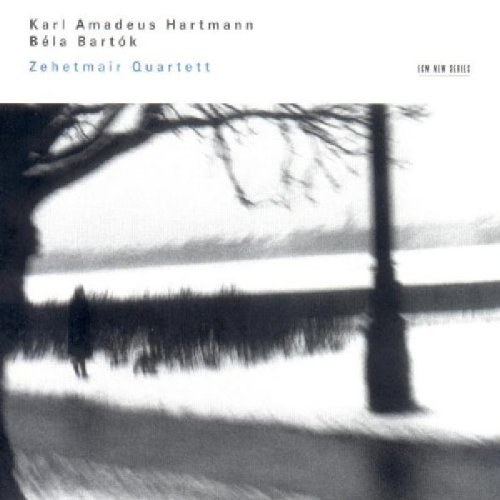
Zehetmair Quartett
Karl Amadeus Hartmann/Bela Bartók
Zehetmair Quartett
Thomas Zehetmair violin
Ulf Schneider violin
Ruth Killius viola
Françoise Groben cello
Strichquartett No. 1
Streichquartett No. 4
Recorded November 1999
ECM New Series 1727
Debut recording of the astonishing quartet of whom The Times of London wrote: "What a group! On they come, devoid of frills, just the instruments, and the music in their heads and fingers. And then they start up, the sound so full-blooded, dangerous and raw. Though the velvet touch is not beyond them, they never dispense dainty milk and honey: you are forcefully aware that this is music-making bold and magical..."
------
This recording marks the beginning of a new chapter in the relationship between violinist Thomas Zehetmair and ECM New Series. The label is pleased to introduce the Zehetmair Quartet, a group whose revelatory concert apperances have already generated a great deal of interest in the music world. Simultaneously with this release, ECM issues a second CD, "Verklarte Nacht" (ECM New Series 1714) in which the Camerata Bern, under the direction of Thomas Zehetmair plays music of Schoenberg, Veress and Bartók.
On its debut album, the Zehetmair Quartet plays string quartets by Karl Amadeus Hartmann and Bela Bartók. As Hermann Conen notes in the CD booklet, barely five years separate the two compositions. "Béla Bartók's Fourth String Quartet, dating from 1928, was still a postlude to the First World War, whereas Karl Amadeus Hartmann's First String Quartet (1933) was already a prelude to the Second. In the powerful maelstrom of this extraordinary period, 'during which peace mimicked war', both composers consciously chose the benchmark genre of the string quartet to convey their message."
Although neither Bartók nor Hartmann was to follow the austere paths toward atonality that the innovations of the Second Vienna School opened up, both composers were profoundly inspired by Alban Berg's Lyric Suite. Bartók first heard it in Baden-Baden in July 1927 and promptly set about penning a response. As with many of the great Hungarian composer's works of the period it also borrows melodic, rhythmic and harmonic ideas from the world of folk music, yet it is its sense of completeness, of being a world unto itself, that Bartók scholars have singled out as the composition's most outstanding attribute. It is often regarded as a "breakthrough" piece in his oeuvre. György Kroó, for instance, wrote that "The String Quartet No. 4 represents that moment in Bartók's development as a composer when he first glimpses infinite horizons and in one sweeping glance perceives his own realm in its entirety. One can still feel the explosive quality of the stupendous force and tension which drove him to create this composition."
Inspiration for Hartmann's three-movement quartet, in turn, came from both Berg's Lyric Suite, and from Bartók's Fourth String Quartet. "But already the slow introduction of the first movement breaks out into independent territory..."
Hartmann wrote his composition in full knowledge that it would not be played in his native Germany for many years - his anti-fascist political stance guaranteed as much - but the work's dedicatee, Hermann Scherchen, helped to find contexts in which it could be heard. When the First String Quartet won First Prize at the 1936 Carillon Competition in Geneva, Hartmann's status as a genuinely "independent German composer" began to be recognised.
Both the Bartók and Hartmann pieces are strong, forcefully driven compositions that demand a fierce commitment from the players. Hermann Conen: "Producing great string quartets is always a challenge to both composers and interpreters. Often lifelong ties are forged and, with them, an authentic thread of tradition....The Zehetmair Quartet takes up this tradition in the very finest sense here. The intensity with which they approach the works is nowhere clearer than in the decision of the musicians assembled around first violinist Thomas Zehetmair to play by heart in concert and in the recording studio. One is almost tempted to add: by heart and with heart." What they propose is an "unhampered journey to the poetic 'heart of the matter'. This is the musicians' way of returning to the origin of their inspiration."
***
The Zehetmair Quartet has met with exceptionally positive press everywhere. 'What a debut! What a group!' critic Geoff Brown raved in the London Times, on the occasion of the group's first British appearances last year. 'There is something elemental about the Zehetmair Quartet. On they come, devoid of frills, just the instruments, and the music in their heads and fingers. And then they start up, the sound so full-blooded, dangerous and raw. Though the velvet touch is not beyond them, they never dispense dainty milk and honey: you are forcefully aware that this is music-making bold and magical...' Reactions at the Glasgow Herald were similar: 'Wow! What a sensation! The Zehetmair Quartet delivered the most stunning performances...The ensemble playing went light years beyond mere close collaboration. The interconnections between every element of the group were astounding, and the effect was electrifying."
The quartet was formed in 1997, by Thomas Zehetmair, long recognised as one of the most resourceful musicians of his generation. Born in Salzburg in 1961, Zehetmair studied violin with his father at the Mozarteum in Salzburg and completed his studies in master courses with Franz Samohyl, Max Rostal and Nathan Milstein. In 1977, he made his debut at the age of sixteen at the Salzburg Festival. The following year, he won first prize in the International Mozart Competition. His first recording, of works by Mozart, was released in 1979.
A soloist of international standing, Zehetmair makes regular guest appearances with such renowned orchestras as the Chicago, Philadelphia, Boston Symphony Orchestras, Cleveland Orchestra, Concertgebouw Orchestra in Amsterdam, Philharmonia Orchestra of London, Dresden Staatskapelle, Leipzig Gewandhaus Orchestra, the Berlin, Munich, and Vienna Philharmonic Orchestras, as well as the Berlin, Cologne, Frankfurt, and Hamburg Radio Orchestras.
Conductors with whom he has worked include Daniel Barenboim, Herbert Blomstedt, Frans Brüggen, Christoph von Dohnányi, Christoph Eschenbach, John Eliot Gardiner, Nikolaus Harnoncourt, Heinz Holliger, Roger Norrington, Simon Rattle, Esa-Pekka Salonen, and Jukka-Pekka Saraste.
His interest in contemporary music is an essential part of his artistic activities. He has given the world premieres of several works, recently including the Violin Concerto of Heinz Holliger. He has recorded with Holliger for ECM New Series (Zehetmair's first recordings for ECM date back to 1984 and performances of Poulenc and Shostakovich from the Lockenhaus Festival).
Thomas Zehetmair has recorded virtually all major repertoire for violin. His recording of the Szymanowsky's Violin Concertos with Simon Rattle and the City of Birmingham Orchestra (on EMI) received the Gramophone Award. His latest recording is of the Beethoven Violin Concerto and Romances with Frans Brüggen, conducting and the Orchestra of the 18th Century.
Zehetmair is also pursuing a second career as a conductor. In recent years he has conducted the Scottish Chamber Orchestra, Camerata Academica Salzburg, Stavanger Symphony, Tapiola Sinfonietta, Northern Sinfonia, among others.
His colleagues in the quartet are Ulf Schneider, second violin, Ruth Killius, viola, and Françoise Groben, violoncello.
Ulf Schneider studied in Hannover with Jens Ellermann, at the Juilliard School in New York with Felix Galimir and Masao Kawasaki, and in Berlin with Thomas Zehetmair. In 1991 he formed the Trio Jean Paul with cellist Martin Löhr and pianist Eckart Heiligers and with this ensemble won first prize awards at international competitions in Osaka, Bonn and Melbourne. Schneider has given concerts worldwide and recorded for the Ars Musici label. He directs a class for violin and chamber music at the Music Academy in Kassel.
Ruth Killius plays much contemporary music, as well as standard repertoire. With the Ensemble Contrechamps she had given many first performances (including, for instance, the String Trio of Brian Ferneyhough) and made CD recordings (trios of Hindemith, Petrassi and Veress etc). She made her ECM New debut in 1994, playing on Giya Kancheli's Exil. Killius studied with Ulrich Kocvj and Kim Kashkashian in Freiburg. From 1993 to 1996 she was solo violist with the Camerata Bern. Other orchestras with whom she has worked include the Residenzorchester Den Haag, Orquesta Sinfonica de Tenerife and Orquesta de Valencia.
Françoise Groben studied at the Cologne Music Academy with Boris Pergamenschikow and took master classes with William Pleeth, Daniel Schafran and members of the Amadeus Quartet. In 1990 she received the Special Prize of the Soviet Artists Association at the Moscow Tchaikovsky Competition as well as the second prize of the Moscow Virtuosi. Since then, she has played all around the world and appeared at many festivals, including Cannes in 1993 at the invitation of Mstislav Rostropovich.
***Further recordings by the Zehetmair Quartet are in preparation, as is a recording of Heinz Holliger's "Violinkonzerts Hommage à Louis Soutter" - already the subject of a film by Edna Politi - with Thomas Zehetmair as soloist.
CD package includes 28-page three-language booklet with liner notes by Hermann Conen
------
This recently formed but already masterly quartet is named after its first violinist, Thomas Zehetmair, a particular admirer of Hartmann. Their account of the first of his two quartets is brilliantly persuasive. A three-movement work manifestly influenced by Bartók, it repays attention. The dying falls of the slow introduction are beguiling, and the way that the fiercely argued main part of the movement keeps returning to a faintly omnious little ostinato is the sort of compelling detail through which one gets to know a new piece. Another is the distraught Bartókian cello declamation of the Con sordino central movement. Bartók's Fourth Quartet, an apt coupling, receives a performance that makes its passionate concision newly astonishing.
Paul Driver, The Sunday Times
This astonishing performance of Bartók's Quartet no. 4 is such a tour-de-force of musical and technical imagination that I scarcely know where to beginn. The Zehetmair Quartet, led by Thomas Zehetmair, plays this intractable masterpiece like some mesmerising choreographic poem. The various textural happenings that litter the music's surface register with such potency that one is compelled to keep reaching for the repeat button simply to re-experience the sonic ailure of a particular message. ... No less compelling in terms of the player's almost telepathic responses is Hartmann's three-movement Quartet no. 1, composed in the combined wake of Bartók's fourth and Berg's Lyric Suite. The neurotic changeability and dynamic restlessness that characterise this deeply unsettling music seemingly hold no terrors for the Zehetmairs, who have been captured by Manfred Eicher in sound of ailuring detail and richness. One of the finest string quartet recordings to have come my way in years.
Julian Haylock, The Strad
Das Zehetmair-Quartett spielt kongenial: Es gelingt den vier Musikern nicht nur, die Intensität und Atmosphäre der Kompositionen stets präzis einzufangen, sie spielen darüber hinaus mit einer seltenen Vehemenz und Homogenität. Selbst noch am unteren Rande der dynamischen Palette beweist das Ensemble eine Klangkultur, mit der sich nur wenige andere Quartette messen können. Wenn ein Superlativ angebracht ist, dann hier: Diese CD ist phänomenal!
Markus Zahnhausen, Klassik Heute
Die Interpretation des Zehetmair Quartetts schafft durch kompromisslose Expressivität Verbindungen zwischen den beiden Werken, und vielleicht ist der Umstand, dass das Ensemble auswendig zu spielen pflegt, tatsächlich der Garant für die Intensität des Klangs, die in jedem Moment der vorliegenden Aufnahme hörbar wird. So kann die abgrundtiefe Trauer der fahlen Einleitung im Kopfsatz von Hartmanns Quartett wohl kaum eindringlicher nachempfunden werden. Um so schärfer wird damit der Kontrast zur aggressiven Explosivität des anschließenden lebhaften Teils spürbar. Mit derselben Leidenschaftlichkeit, die gleichwohl immer einen vibrierenden Rest von Beherrschtheit bewahrt, geht das Ensemble auch in Bartóks Streichquartett zu Werke.
Susanne Schaal-Gotthardt, Neue Zeitschrift für Musik
Hartmanns Carillon-Quartett ... wird in den Ecksätzen geradezu besessen intensiv und gierig drängend vorangetrieben; als spiele ein Schlagzeug, können die Bögen, mitunter geräuschhaft gestrichen, "con tutta forza" tönen, wie der Komponist es im dritten Satz vorschreibt. Der Mittelsatz hingegen wird zu einer ätherischen, zerbrechlichen Insel nach innen gekehrten Schmerzes über den vorausgeahnten Krieg. ... Bartóks fünfsätzig-symmetrisches viertes Quartett ist danach furios gespannt zwischen äußerster Schroffheit und gläserner Klarheit - mit mannigfachen Klangstufen dazwischen.
Ellen Kohlhaas, Frankfurter Allgemeine Zeitung
-------