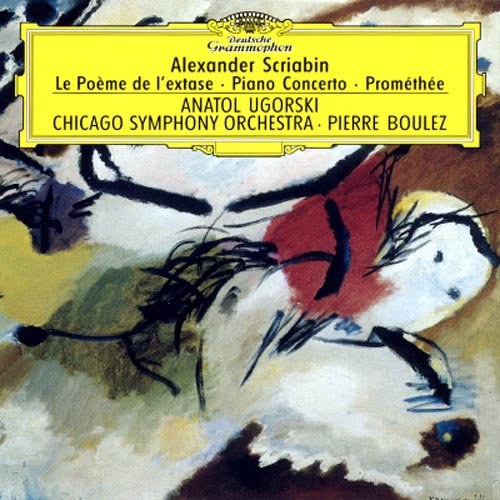
If you want to hear music suited to the millennial frenzy, a prime place to start is with Russian maverick composer Alexander Scriabin. In the final years of his unfortunately brief life, he dreamed up transcendent musical projects that make Wagner seem like parlor entertainment. Among the relatively few orchestral works Scriabin did complete are some stunners that blaze a uniquely visionary, idiosyncratic path beyond the impasse of ripe fin-de-siècle romanticism. The three starkly contrasting pieces gathered here offer a splendid entrée into his music. Henry Miller once described the Poem of Ecstasy as "a bath of cocaine, ice, and rainbows." Boulez conjures oceanic heavings and flickering, perfumed washes of color from his players, leading to a mighty orgasm of sound. The composer was also a dynamic virtuoso pianist (a classmate of Rachmaninoff's), and his early concerto shows its debt to Chopin while pursuing an original and tightly integrated blend of soloist and orchestra. Pianist Anatol Ugorski's unflapping conviction reveals the piece for the gem it is--the slow movement's melody is particularly indelible--leaving you wondering why this concerto is programmed so rarely. The piano also adds an important color in Scriabin's 1910 symphonic poem Prometheus, where he ventures even beyond the Poem of Ecstasy into progressive musical territory. From this amalgam of occult mysticism and pioneering harmony, Boulez fashions a majestically textured, multidimensional account that sounds opulent but unclotted. If this whets your appetite for a truly unique composer, try the Scriabin twofer on Chandos that includes his bizarrely brilliant Divine Poem Symphony. --Thomas May