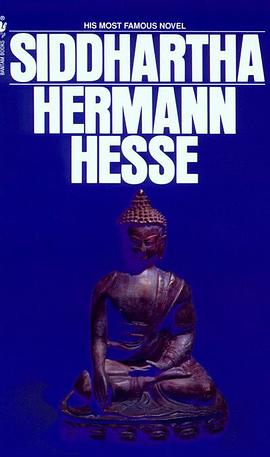
Siddhartha is a novel by Hermann Hesse that deals with the spiritual journey of a boy known as Siddhartha from the Indian subcontinent during the time of the Buddha.
The book, Hesse's ninth novel, was written in German, in a simple yet powerful and lyrical style. It was published in the U.S. in 1951 and became influential during the 1960s. Hesse dedicated Siddhartha to Ninon Hesse, his wife.
The word Siddhartha is made up of two words in the Sanskrit language, siddha (achieved) + artha (meaning or wealth). The two words together mean "he who has found meaning (of existence)" or "he who has attained his goals".[1] The Buddha's name, before his renunciation, was Prince Siddhartha Gautama. In this book, the Buddha is referred to as "Gotama".
The story begins as Siddhartha, the son of a Brahmin, leaves his home to join the ascetics with his companion Govinda. The two set out in the search of enlightenment.
Siddhartha goes from asceticism, to a very worldly life as a trader with a lover, and back to asceticism as he attempts to achieve this goal.
The story takes place in ancient India around the time of Gautama Buddha (likely between the fourth and seventh centuries BC[2]).
Experience is the aggregate of conscious events experienced by a human in life – it connotes participation, learning and knowledge. Understanding is comprehension and internalization. In Hesse’s novel Siddhartha, experience is shown as the best way to approach understanding of reality and attain enlightenment – Hesse’s crafting of Siddhartha’s journey shows that understanding is attained not through scholastic, mind-dependent methods, nor through immersing oneself in the carnal pleasures of the world and the accompanying pain of samsara; however, it is the totality of these experiences that allow Siddhartha to attain understanding.
Thus, the individual events are meaningless when considered by themselves—Siddhartha’s stay with the samanas and his immersion in the worlds of love and business do not lead to nirvana, yet they cannot be considered distractions, for every action and event that is undertaken and happens to Siddhartha helps him to achieve understanding. The sum of these events is thus experience.