电影


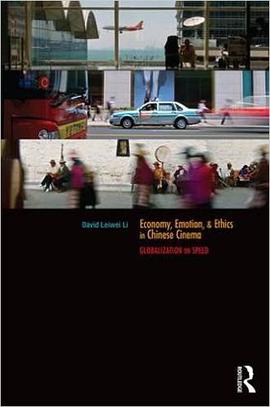
Economy, Emotion, and Ethics in Chinese Cinema
Douban
David Leiwei Li
publishing house:
Routledge
2016
- 3
The First and Second Comings of capitalism are conceptual shorthands used to capture the radical changes in global geopolitics from the Opium War to the end of the Cold War and beyond. Centring the role of capitalism in the Chinese everyday, the framework can be employed to comprehend contemporary Chinese culture in general and, as in this study, Chinese cinema in particular.
This book investigates major Chinese-language films from mainland China, Taiwan, and Hong Kong in order to unpack a hyper-compressed capitalist modernity with distinctive Chinese characteristics. As a dialogue between the film genre as a mediation of microscopic social life, and the narrative of economic development as a macroscopic political abstraction, it engages the two otherwise remotely related worlds, illustrating how the State and the Subject are reconstituted cinematically in late capitalism. A deeply cultural, determinedly historical, and deliberately interdisciplinary study, it approaches "culture" anthropologically, as a way of life emanating from the everyday, and aesthetically, as imaginative forms and creative expressions.
Economy, Emotion, and Ethics in Chinese Cinema will appeal to students and scholars of Chinese cinema, cultural studies, Asian studies, and interdisciplinary studies of politics and culture.

世上的光
Instant Light: Tarkovsky Polaroids Douban● 热爱电影的人都知道他——安德列·塔可夫斯基,太多人因为他而爱上了电影。
● 他的作品每一部都是经典,都让他名留影史。
● 他的诗性叙事开创了崭新的艺术典范,奠定了他在世界电影史上无可争议的大师地位。
● 塔氏博大且宁静深邃的精神气质,透过拍立得,让无数人惊鸿一瞥。
● 正如他的电影那样,照片缓缓流出感伤与爱意,传达着他的孤独、哲学和关怀。
● 在这里,塔式的时光穿越镜头,烙印于画面之中,不知不觉,让人沉迷其间。
● 他的影像的无穷魅力,引领读者进入一种凝视与冥想的状态,并渐渐安静下来,无声地观看这个世界。在沉静之中抵达超越性的想象、思考与诗性体验。
本书是塔可夫斯基的摄影随笔,也是他最独特的一本摄影集。收集了塔可夫斯基在1979年至1984年之间,在俄国和意大利所拍的69张照片,即塔可夫斯基完成《潜行者》(Stalker,1979)之后,在《乡愁》(Nostalgia,1983)摄制期间所拍的。这一系列精粹出色的生活小品让我们看到,这位导演不单是流动影像的大师,在捕捉画面上也同样杰出。
