Neuroscience
Who's in Charge?
Douban Goodreads
Michael S. Gazzaniga publishing house: Ecco 2011 - 11 other title: Who's in Charge? Free Will and the Science of the Brain
“Big questions are Gazzaniga’s stock in trade.” —New York Times “Gazzaniga is one of the most brilliant experimental neuroscientists in the world.” —Tom Wolfe “Gazzaniga stands as a giant among neuroscientists, for both the quality of his research and his ability to communicate it to a general public with infectious enthusiasm.” —Robert Bazell, Chief Science Correspondent, NBC News The author of Human, Michael S. Gazzaniga has been called the “father of cognitive neuroscience.” In his remarkable book, Who’s in Charge?, he makes a powerful and provocative argument that counters the common wisdom that our lives are wholly determined by physical processes we cannot control. His well-reasoned case against the idea that we live in a “determined” world is fascinating and liberating, solidifying his place among the likes of Oliver Sacks, Antonio Damasio, V.S. Ramachandran, and other bestselling science authors exploring the mysteries of the human brain.
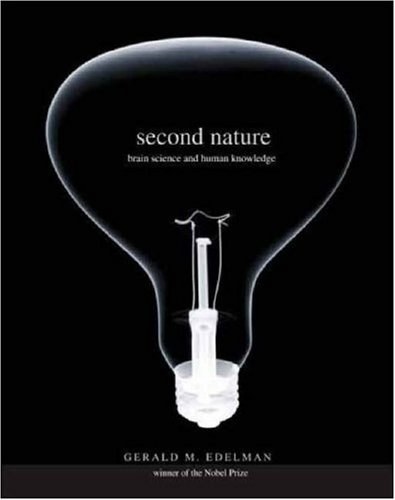
Second Nature
Douban
Gerald M. Edelman publishing house: Yale University Press 2006 - 10
Burgeoning advancements in brain science are opening up new perspectives on how we acquire knowledge. Indeed, it is now possible to explore consciousness—the very center of human concern—by scientific means. In this illuminating book, Dr. Gerald M. Edelman offers a new theory of knowledge based on striking scientific findings about how the brain works. And he addresses the related compelling question: Does the latest research imply that all knowledge can be reduced to scientific description? Edelman’s brain-based approach to knowledge has rich implications for our understanding of creativity, of the normal and abnormal functioning of the brain, and of the connections among the different ways we have of knowing. While the gulf between science and the humanities and their respective views of the world has seemed enormous in the past, the author shows that their differences can be dissolved by considering their origins in brain functions. He foresees a day when brain-based devices will be conscious, and he reflects on this and other fascinating ideas about how we come to know the world and ourselves.
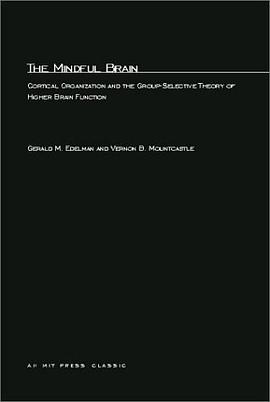
Mindful Brain
Douban
Gerald M. Edelman / Vernon B. Mountcastle publishing house: The MIT Press 1982 - 3
This significant contribution to neuroscience consists of two papers, the first by Mountcastle an, the second by Edelman. Between them, they examine from different but complementary directions the relationships that connect the higher brain--memory, learning, perception, thinking--with what goes on at the most basic levels of neural activity, with particular stress on the role of local neuronal circuits.Edelman's major hypothesis is that "the conscious state results from phasic reentrant signaling occurring in parallel processes that involve associations between stored patterns and current sensory or internal input." This selective process occurs by the polling of degenerate primary repertoires of neuronal groups that are formed during embryogenesis and development. Edelman's theory extrapolates to the brain the selectionistic immunological theories for which he was awarded the 1972 Nobel Prize in Physiology or Medicine.Mountcastle's paper reviews what is known about the actual structure of various parts of the neo cortex. He relates the large entities of the neocortex to their component modules--the local neuronal circuits--and shows how the complex interrelationships of such a distributed system can yield dynamic distributed functioning.There are strong conceptual parallels between Mountcastle's idea of cortical columns and their functional subunits and Edelman's concept of populations of neurons functioning as processors in a brain system based on selectional rather than instructional principles. These parallels are traced and put into perspective in Francis Schmitt's Introduction.