Finance

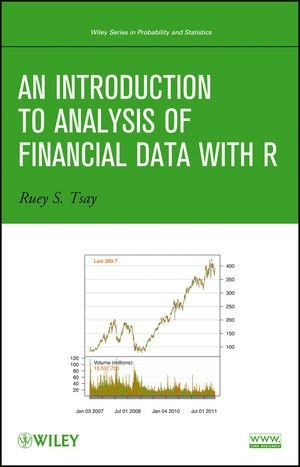
An Introduction to Analysis of Financial Data with R
Douban GoodreadsThis book provides a systematic and mathematically accessible introduction to financial econometric models and their applications in modeling and predicting financial time series data. It emphasizes empirical financial data and focuses on real-world examples. Following this approach, readers will master key aspects of financial time series, including volatility modeling, neural network applications, market microstructure, and high-frequency financial data. S-Plus® commands and illustrations are used extensively throughout the book in order to highlight accurate interpretations and graphical representations of financial data. Exercises are included in order to provide readers with more opportunities to put the models and methods into everyday practice. The tools provided in the text aid readers in developing a deeper understanding of financial markets through firsthand experience in working with financial data, most importantly without needless computation.
Foundations of Financial Markets and Institutions
Foundations of Financial Markets and Institutions Douban Goodreads
Frank J. Fabozzi
/
Franco P. Modigliani
…
publishing house:
Prentice Hall
2009
- 2
A comprehensive exploration of the world's financial markets and institutions. Introduction; Financial Institutions, Financial Intermediaries, and Asset Management Firms; Depository Institutions: Activities and Characteristics; The U.S. Federal Reserve and the Creation of Money; Monetary Policy in the United States; Insurance Companies; Investment Companies and Exchange-Traded Funds; Pension Funds; Properties and Pricing of Financial Assets; The Level and Structure of Interest Rates; The Term Structure of Interest Rates; Risk/Return and Asset Pricing Models; Primary Markets and the Underwriting of Securities; Secondary Markets; Treasury and Agency Securities Markets; Municipal Securities Markets; Markets for Common Stock: The Basic Characteristics; Markets for Common Stock: Structure and Organization; Markets for Corporate Senior Instruments: I; Markets for Corporate Senior Instruments: II; The Markets for Bank Obligations; The Residential Mortgage Market; Residential Mortgage-Backed Securities Market; Market for Commercial Mortgage Loans and Commercial Mortgage-Backed Securities; Market for Asset-Backed Securities; Financial Futures Markets; Options Markets; Pricing of Futures and Options Contracts; The Applications of Futures and Options Contracts; OTC Interest Rate Derivatives: Forward Rate Agreements, Swaps, Caps, and Floors; Market for Credit Risk Transfer Vehicles: Credit Derivatives and Collateralized Debt Obligations; The Market for Foreign Exchange and Risk Control Instruments MARKET : Foundations of Financial Markets and Institutions , offers a comprehensive exploration of the revolutionary developments occurring in the world's financial markets and institutions –i.e., innovation, globalization, and deregulation–with a focus on the actual practices of financial institutions, investors, and financial instruments.

Market Wizards
Market Wizards Douban Goodreads
Jack D. Schwager
publishing house:
Collins
1993
- 1
A bestselling classic (more than 200,000 copies sold in hardcover and paperback) that delves into the minds of some of the world's most successful traders.
Swimming with Sharks
Douban
Joris Luyendijk
publishing house:
Guardian Faber Publishing
2015
- 9
Joris Luyendijk, an investigative journalist, knew as much about banking as the average person: almost nothing. Bankers, he thought, were ruthless, competitive, bonus-obsessed sharks, irrelevant to his life. And then he was assigned to investigate the financial sector. Joris immersed himself in the City for a few years, speaking to over 200 people - from the competitive investment bankers and elite hedge-fund managers to downtrodden back-office staff, reviled HR managers and those made redundant in the regular 'culls'. Breaking the strictly imposed code of secrecy and silence, these insiders talked to Joris about what they actually do all day, how they see themselves and what makes them tick. They opened up about the toxic hiring and firing culture. They confessed to being overwhelmed by technological and mathematical opacity. They admitted that when Lehman Brothers went down in 2008 they hoarded food, put their money in gold and prepared to evacuate their children to the countryside. They agreed that nothing has changed since the crash. Joris had a chilling realisation. What if the bankers themselves aren't the real enemy? What if the truth about global finance is more sinister than that?
Liar's Poker
Douban
Michael Lewis
publishing house:
Hodder Paperbacks
2006
- 6
Liar's Poker is a non-fiction, semi-autobiographical book by Michael Lewis describing the author's experiences as a bond salesman on Wall Street during the late 1980s. First published in 1989, it is considered one of the books that define Wall Street during the 1980s, along with Barbarians at the Gate and the fictional The Bonfire of the Vanities by Tom Wolfe. The book captures well an important period in the history of Wall Street. Two important figres in that history feature prominantly in the text, head of mortgage department Lewie Ranieri and firm CEO John Gutfreund.
The book's name is taken from Liar's poker, a gambling game popular with the bond traders in the book and played for high stakes.
Liar's Poker follows two different story threads, though not necessarily in chronological order.
The first thread is autobiographical, and follows Lewis through his college education and his hiring by Salomon Brothers in 1984. This part of the book gives a first-person account of how bond traders and salesmen truly work, their personalities, and their culture. The book captures well an important period in the history of Wall Street. Two important figures in that history feature prominently in the text, head of mortgage department Lewie Ranieri and firm CEO John Gutfreund.
The second thread is a sort of history of Salomon Brothers and overview of Wall Street in general, especially how the firm single-handedly created a market for mortgage bonds and made the firm wealthy, only to be outdone by Michael Milken and his junk bonds. This thread is less dependent on Lewis' personal experience and features quotes apparently drawn from interviews with various relevant figures.
Lewis jumps back and forth between these two threads in the book.