Mathematics
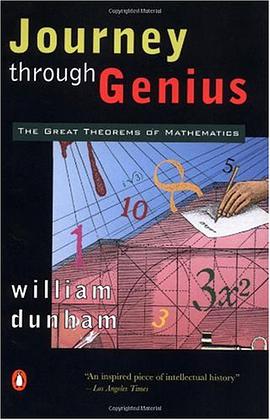
Journey through Genius
Douban
[美国] 威廉·邓纳姆 publishing house: Penguin Books 1991 - 8
Praise for William Dunhams Journey Through Genius The Great Theorems of Mathematics "Dunham deftly guides the reader through the verbal and logical intricacies of major mathematical questions and proofs, conveying a splendid sense of how the greatest mathematicians from ancient to modern times presented their arguments." —Ivars Peterson Author, The Mathematical Tourist Mathematics and Physics Editor, Science News "It is mathematics presented as a series of works of art; a fascinating lingering over individual examples of ingenuity and insight. It is mathematics by lightning flash." —Isaac Asimov "It is a captivating collection of essays of major mathematical achievements brought to life by the personal and historical anecdotes which the author has skillfully woven into the text. This is a book which should find its place on the bookshelf of anyone interested in science and the scientists who create it." —R. L. Graham, AT&T Bell Laboratories "Come on a time-machine tour through 2,300 years in which Dunham drops in on some of the greatest mathematicians in history. Almost as if we chat over tea and crumpets, we get to know them and their ideas—ideas that ring with eternity and that offer glimpses into the often veiled beauty of mathematics and logic. And all the while we marvel, hoping that the tour will not stop." —Jearl Walker, Physics Department, Cleveland State University Author of The Flying Circus of Physics
具体数学(英文版第2版)
Concrete Mathematics: A Foundation for Computer Science (2/e) Douban Goodreads
★ 10.0 5 ratings
[美] Ronald L. Graham / Donald E. Knuth … publishing house: 机械工业出版社 2002 - 8
This book introduces the mathematics that supports advanced computer Programming and the analysis of algorithms. The primary aim of its well-known authors is to provide a solid and relevant base of mathematical skills--the skills needed to solve complex problems, to evaluate horrendous sums, and to discover subtle Patterns in data. It is an indispensable text and reference not only for computer scientists--the authors themselves rely heavily on it! but for serious users Of mathematics in virtually every discipline. Concrete mathematics is a blending of continuous and disCRETE mathematics: "More concretely," the authors explain, "it is the controlled manipulation of mathematical formulas,using a collection of techniques for solving problems." The subject mater is primarily an expansion of the Mathematical Preliminaries section in Knuth's c1assic Art of Computer Programming, but the style of presentation is more leisurely, and individual topics are covered more deeply. Several new topics have been added, and the most significant ideas have been traced to their historical roots. The book includes more than 500 exercises, divided into six categories. Complete answers are provided for all exercises, except research problems, making the book particularly valuable for self-study.
How to Solve It
G. Polya Douban Goodreads Skybridge
G. Polya publishing house: Princeton University Press 2004 - 4 other title: How to Solve It: A New Aspect of Mathematical Method
A perennial bestseller by eminent mathematician G. Polya, "How to Solve It" will show anyone in any field how to think straight. In lucid and appealing prose, Polya reveals how the mathematical method of demonstrating a proof or finding an unknown can be of help in attacking any problem that can be "reasoned" out - from building a bridge to winning a game of anagrams. Generations of readers have relished Polya's deft - indeed, brilliant - instructions on stripping away irrelevancies and going straight to the heart of the problem. In this best-selling classic, George Polya revealed how the mathematical method of demonstrating a proof or finding an unknown can be of help in attacking any problem that can be "reasoned" out - from building a bridge to winning a game of anagrams.Generations of readers have relished Polya's deft instructions on stripping away irrelevancies and going straight to the heart of a problem. "How to Solve It" popularized heuristics, the art and science of discovery and invention. It has been in print continuously since 1945 and has been translated into twenty-three different languages. Polya was one of the most influential mathematicians of the twentieth century. He made important contributions to a great variety of mathematical research: from complex analysis to mathematical physics, number theory, probability, geometry, astronomy, and combinatorics. He was also an extraordinary teacher - he taught until he was ninety - and maintained a strong interest in pedagogical matters throughout his long career.In addition to "How to Solve It", he published a two-volume work on the topic of problem solving, "Mathematics of Plausible Reasoning", also with Princeton. Polya is one of the most frequently quoted mathematicians, and the following statements from "How to Solve It" make clear why: "My method to overcome a difficulty is to go around it." "Geometry is the science of correct reasoning on incorrect figures." "In order to solve this differential equation you look at it till a solution occurs to you."
Introduction to Calculus and Analysis, Vol. 1
Douban
Richard Courant / Fritz John publishing house: Springer 1998
From the reviews: "Volume 1 covers a basic course in real analysis of one variable and Fourier series. It is well-illustrated, well-motivated and very well-provided with a multitude of unusually useful and accessible exercises. (...) There are three aspects of Courant and John in which it outshines (some) contemporaries: (i) the extensive historical references, (ii) the chapter on numerical methods, and (iii) the two chapters on physics and geometry. The exercises in Courant and John are put together purposefully, and either look numerically interesting, or are intuitively significant, or lead to applications. It is the best text known to the reviewer for anyone trying to make an analysis course less abstract. (...)" The Mathematical Gazette (75.1991.471