
Python

Data Science from Scratch
Douban
Joel Grus
publishing house:
O'Reilly Media
2015
- 4
Data science libraries, frameworks, modules, and toolkits are great for doing data science, but they’re also a good way to dive into the discipline without actually understanding data science. In this book, you’ll learn how many of the most fundamental data science tools and algorithms work by implementing them from scratch.
If you have an aptitude for mathematics and some programming skills, author Joel Grus will help you get comfortable with the math and statistics at the core of data science, and with hacking skills you need to get started as a data scientist. Today’s messy glut of data holds answers to questions no one’s even thought to ask. This book provides you with the know-how to dig those answers out.
Get a crash course in Python
Learn the basics of linear algebra, statistics, and probability—and understand how and when they're used in data science
Collect, explore, clean, munge, and manipulate data
Dive into the fundamentals of machine learning
Implement models such as k-nearest Neighbors, Naive Bayes, linear and logistic regression, decision trees, neural networks, and clustering
Explore recommender systems, natural language processing, network analysis, MapReduce, and databases
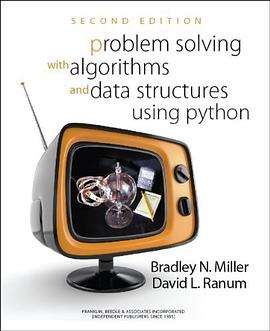
Problem Solving with Algorithms and Data Structures Using Python (2/e)
Douban
Bradley N. Miller
/
David L. Ranum
publishing house:
Franklin, Beedle & Associates
2011
- 8

Python Data Science Handbook
Douban Goodreads
Jake VanderPlas
publishing house:
O'Reilly Media
2016
- 6
For many researchers, Python is a first-class tool mainly because of its libraries for storing, manipulating, and gaining insight from data. Several resources exist for individual pieces of this data science stack, but only with the Python Data Science Handbook do you get them all-IPython, NumPy, Pandas, Matplotlib, Scikit-Learn, and other related tools. Working scientists and data crunchers familiar with reading and writing Python code will find this comprehensive desk reference ideal for tackling day-to-day issues: manipulating, transforming, and cleaning data; visualizing different types of data; and using data to build statistical or machine learning models. Quite simply, this is the must-have reference for scientific computing in Python. With this handbook, you'll learn how to use: IPython and Jupyter: provide computational environments for data scientists using Python NumPy: includes the ndarray for efficient storage and manipulation of dense data arrays in Python Pandas: features the DataFrame for efficient storage and manipulation of labeled/columnar data in Python Matplotlib: includes capabilities for a flexible range of data visualizations in Python Scikit-Learn: for efficient and clean Python implementations of the most important and established machine learning algorithms