Statistics
An Introduction to Statistical Learning
Douban Goodreads
★ 9.8 12 ratings
Gareth James / Daniela Witten … publishing house: Springer 2013 - 8
An Introduction to Statistical Learning provides an accessible overview of the field of statistical learning, an essential toolset for making sense of the vast and complex data sets that have emerged in fields ranging from biology to finance to marketing to astrophysics in the past twenty years. This book presents some of the most important modeling and prediction techniques, along with relevant applications. Topics include linear regression, classification, resampling methods, shrinkage approaches, tree-based methods, support vector machines, clustering, and more. Color graphics and real-world examples are used to illustrate the methods presented. Since the goal of this textbook is to facilitate the use of these statistical learning techniques by practitioners in science, industry, and other fields, each chapter contains a tutorial on implementing the analyses and methods presented in R, an extremely popular open source statistical software platform. Two of the authors co-wrote The Elements of Statistical Learning (Hastie, Tibshirani and Friedman, 2nd edition 2009), a popular reference book for statistics and machine learning researchers. An Introduction to Statistical Learning covers many of the same topics, but at a level accessible to a much broader audience. This book is targeted at statisticians and non-statisticians alike who wish to use cutting-edge statistical learning techniques to analyze their data. The text assumes only a previous course in linear regression and no knowledge of matrix algebra.
The Art of Statistics
Douban
David Spiegelhalter publishing house: Pelican 2019 - 3
Statistics has played a leading role in our scientific understanding of the world for centuries, yet we are all familiar with the way statistical claims can be sensationalised, particularly in the media. In the age of big data, as data science becomes established as a discipline, a basic grasp of statistical literacy is more important than ever. In The Art of Statistics, David Spiegelhalter guides the reader through the essential principles we need in order to derive knowledge from data. Drawing on real world problems to introduce conceptual issues, he shows us how statistics can help us determine the luckiest passenger on the Titanic, whether serial killer Harold Shipman could have been caught earlier, and if screening for ovarian cancer is beneficial. How many trees are there on the planet? Do busier hospitals have higher survival rates? Why do old men have big ears? Spiegelhalter reveals the answers to these and many other questions - questions that can only be addressed using statistical science.
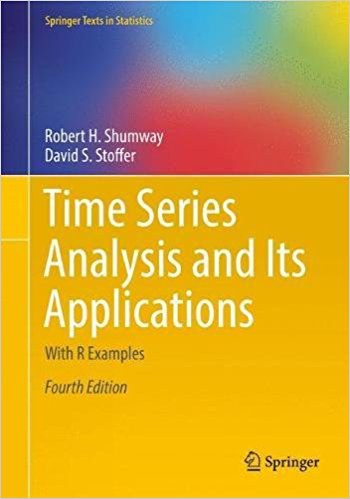
Time Series Analysis and Its Applications
Douban
Robert H. Shumway / David S. Stoffer publishing house: Springer 2017 - 4
The fourth edition of this popular graduate textbook, like its predecessors, presents a balanced and comprehensive treatment of both time and frequency domain methods with accompanying theory. Numerous examples using nontrivial data illustrate solutions to problems such as discovering natural and anthropogenic climate change, evaluating pain perception experiments using functional magnetic resonance imaging, and monitoring a nuclear test ban treaty. The book is designed as a textbook for graduate level students in the physical, biological, and social sciences and as a graduate level text in statistics. Some parts may also serve as an undergraduate introductory course. Theory and methodology are separated to allow presentations on different levels. In addition to coverage of classical methods of time series regression, ARIMA models, spectral analysis and state-space models, the text includes modern developments including categorical time series analysis, multivariate spectral methods, long memory series, nonlinear models, resampling techniques, GARCH models, ARMAX models, stochastic volatility, wavelets, and Markov chain Monte Carlo integration methods. This edition includes R code for each numerical example in addition to Appendix R, which provides a reference for the data sets and R scripts used in the text in addition to a tutorial on basic R commands and R time series.An additional file is available on the book’s website for download, making all the data sets and scripts easy to load into R.
Probability Theory
Probability Theory: The Logic of Science Douban Goodreads
E. T. Jaynes publishing house: 劍橋大學出版社 2003 - 6
The standard rules of probability can be interpreted as uniquely valid principles in logic. In this book, E. T. Jaynes dispels the imaginary distinction between 'probability theory' and 'statistical inference', leaving a logical unity and simplicity, which provides greater technical power and flexibility in applications. This book goes beyond the conventional mathematics of probability theory, viewing the subject in a wider context. New results are discussed, along with applications of probability theory to a wide variety of problems in physics, mathematics, economics, chemistry and biology. It contains many exercises and problems, and is suitable for use as a textbook on graduate level courses involving data analysis. The material is aimed at readers who are already familiar with applied mathematics at an advanced undergraduate level or higher. The book will be of interest to scientists working in any area where inference from incomplete information is necessary.
How to Lie with Statistics
How to Lie With Statistics Douban Goodreads
★ 8.5 8 ratings
Darrell Huff publishing house: W. W. Norton & Company 1993 - 10
"There is terror in numbers," writes Darrell Huff in How to Lie with Statistics. And nowhere does this terror translate to blind acceptance of authority more than in the slippery world of averages, correlations, graphs, and trends. Huff sought to break through "the daze that follows the collision of statistics with the human mind" with this slim volume, first published in 1954. The book remains relevant as a wake-up call for people unaccustomed to examining the endless flow of numbers pouring from Wall Street, Madison Avenue, and everywhere else someone has an axe to grind, a point to prove, or a product to sell. "The secret language of statistics, so appealing in a fact-minded culture, is employed to sensationalize, inflate, confuse, and oversimplify," warns Huff. Although many of the examples used in the book are charmingly dated, the cautions are timeless. Statistics are rife with opportunities for misuse, from "gee-whiz graphs" that add nonexistent drama to trends, to "results" detached from their method and meaning, to statistics' ultimate bugaboo--faulty cause-and-effect reasoning. Huff's tone is tolerant and amused, but no-nonsense. Like a lecturing father, he expects you to learn something useful from the book, and start applying it every day. Never be a sucker again, he cries! Even if you can't find a source of demonstrable bias, allow yourself some degree of skepticism about the results as long as there is a possibility of bias somewhere. There always is. Read How to Lie with Statistics. Whether you encounter statistics at work, at school, or in advertising, you'll remember its simple lessons. Don't be terrorized by numbers, Huff implores. "The fact is that, despite its mathematical base, statistics is as much an art as it is a science." --Therese Littleton
The Elements of Statistical Learning
Douban Goodreads
★ 9.8 10 ratings
Trevor Hastie / Robert Tibshirani … publishing house: Springer 2009 - 10
During the past decade there has been an explosion in computation and information technology. With it have come vast amounts of data in a variety of fields such as medicine, biology, finance, and marketing. The challenge of understanding these data has led to the development of new tools in the field of statistics, and spawned new areas such as data mining, machine learning, and bioinformatics. Many of these tools have common underpinnings but are often expressed with different terminology. This book describes the important ideas in these areas in a common conceptual framework. While the approach is statistical, the emphasis is on concepts rather than mathematics. Many examples are given, with a liberal use of color graphics. It is a valuable resource for statisticians and anyone interested in data mining in science or industry. The book's coverage is broad, from supervised learning (prediction) to unsupervised learning. The many topics include neural networks, support vector machines, classification trees and boosting---the first comprehensive treatment of this topic in any book. This major new edition features many topics not covered in the original, including graphical models, random forests, ensemble methods, least angle regression & path algorithms for the lasso, non-negative matrix factorization, and spectral clustering. There is also a chapter on methods for "wide" data (p bigger than n), including multiple testing and false discovery rates.
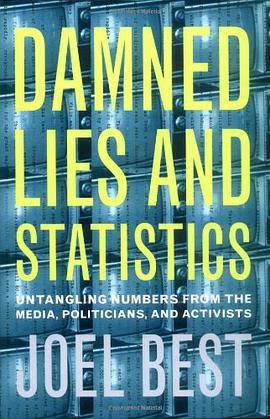
Damned Lies and Statistics
Douban
Joel Best publishing house: University of California Press 2001 - 5
Does the number of children gunned down double each year? Does anorexia kill 150,000 young women annually? Do white males account for only a sixth of new workers? Startling statistics shape our thinking about social issues. But all too often, these numbers are wrong. This book is a lively guide to spotting bad statistics and learning to think critically about these influential numbers. "Damned Lies and Statistics" is essential reading for everyone who reads or listens to the news, for students, and for anyone who relies on statistical information to understand social problems. Joel Best bases his discussion on a wide assortment of intriguing contemporary issues that have garnered much recent media attention, including abortion, cyberporn, homelessness, the Million Man March, teen suicide, the U.S. census, and much more. Using examples from the "New York Times", the "Washington Post", and other major newspapers and television programs, he unravels many fascinating examples of the use, misuse, and abuse of statistical information. In this book Best shows us exactly how and why bad statistics emerge, spread, and come to shape policy debates. He recommends specific ways to detect bad statistics, and shows how to think more critically about 'stat wars', or disputes over social statistics among various experts. Understanding this book does not require sophisticated mathematical knowledge; Best discusses the most basic and most easily understood forms of statistics, such as percentages, averages, and rates. This accessible book provides an alternative to either naively accepting the statistics we hear or cynically assuming that all numbers are meaningless. It shows how anyone can become a more intelligent, critical, and empowered consumer of the statistics that inundate both the social sciences and our media-saturated lives.