ecm
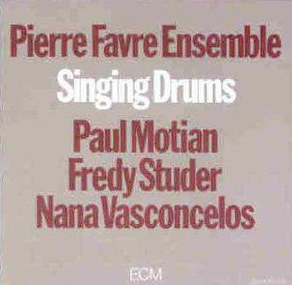
Singing Drums
Douban
Pierre Favre Ensemble
release date 1991-07-01
publisher:
Polygram Records
在上世纪40年代初期,面对突然发生爵士上的新变化,一位先辈预言:“爵士很有可能就是这样从一个男人击鼓开始。”
皮埃尔·法瓦,一位横垮爵士与前卫音乐、世界音乐的巨人,瑞士国宝级音乐家。他一共出版过65张专辑之多,在著名的ECM公司出版过10张专辑,是ECM公司标志性的人物之一。皮埃尔·法瓦既是一位伟大的鼓手和打击乐手,又是一位打击乐器的发明家,同时也是杰出的作曲家和乐团领导者。他不单是爵士乐的集大成者,也善于在前卫音乐领域开拓爵士乐与其他音乐对话的无穷可能性.
Fleuve
Douban
Pierre Favre Ensemble
release date 2006-02-11
publisher:
Ecm Records
Swiss drummer-composer Pierre Favre has been bringing new impulses to European jazz since the 1960s. At home with all of the music’s styles, from New Orleans to bop to free playing, he is in every context a uniquely lyrical, melodically-minded drummer. The range of ECM musicians with whom Favre has played gives an index of his open-mindedness: from Dino Saluzzi to Arvo Pärt to John Surman and Barre Phillips. His leader dates for the label have included discs with Kenny Wheeler and Steve Swallow (“Window Steps”, 1995) with singer Tamia (“De la nuit... le jour”, 1987, “Solitudes”, 1991) with fellow percussionists Paul Motian, Fredy Studer and Nana Vasconcelos (1984).
“Fleuve” introduces his new ensemble, a group of most unorthodox line-up. With tuba, double-bass and bass guitar, the music does not lack authority at the bottom end when needed, but it is also highly mobile and agile, and is given plenty of room to move inside Manfred Eicher’s spacious production. Its music is elegant, sinuous, poetic, its timbres and textures surprisingly evocative of renaissance music, its lyricism timeless. In Favre’s pieces, the differentiated dynamics, arrangements and melody are influenced and developed primarily from the sound colours of his solo percussion playing. Sometimes drums, harp, bass and guitar function as a core ‘rhythm group’ inside which musical ideas are perpetually interchanged, with tuba/serpent and reeds as frontline voices. Just as often, however, the contributions of all seven musicians overlap contrapuntally, a procedure that has its roots in traditional jazz, utilised to decidedly non-traditional effect.
ARTISTS
Philipp Schaufelberger: guitar
Frank Kroll: soprano saxophone, bass clarinet
Hélène Breschand: harp
Michel Godard: bass guitar
Wolfgang Zwiauer: bass guitar
Bänz Oester: double-bass
Pierre Favre: percussion, drums