
Agamben
Nudities Douban
Nudities
author: Giorgio Agamben translator: Stefan Pedatella publishing house: Stanford University Press 2010 - 11
Encompassing a wide range of subjects, the ten masterful essays gathered here may at first appear unrelated to one another. In truth, Giorgio Agamben's latest book is a mosaic of his most pressing concerns. Take a step backward after reading it from cover to cover, and a world of secret affinities between the chapters slowly comes into focus. Take another step back, and it becomes another indispensable piece of the finely nuanced philosophy that Agamben has been patiently constructing over four decades of sustained research.
If nudity is unconcealment, or the absence of all veils, then Nudities is a series of apertures onto truth. A guiding thread of this collection—weaving together the prophet's work of redemption, the glorious bodies of the resurrected, the celebration of the Sabbath, and the specters that stroll the streets of Venice—is inoperativity, or the cessation of work. The term should not be understood as laziness or inertia, but rather as the paradigm of human action in the politics to come. Itself the result of inoperativity, Nudities shuttles between philosophy and poetry, philological erudition and unexpected digression, metaphysical treatise and critique of modern life. And whether the subject at hand is personal identity or the biometric apparatus, the slanderer or the land surveyor, Kafka or Kleist, every page bears the singular imprint of one of the most astute philosophers of our time.
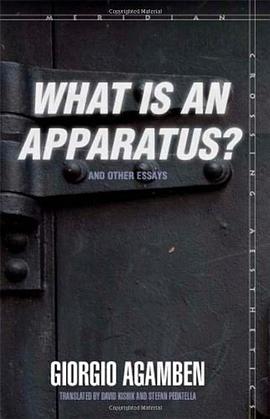
"What Is an Apparatus?" and Other Essays Douban
author: Giorgio Agamben translator: David Kishik / Stefan Pedatella publishing house: Stanford University Press 2009 - 5
The three essays collected in this book offer a succinct introduction to Agamben's recent work through an investigation of Foucault's notion of the apparatus, a meditation on the intimate link of philosophy to friendship, and a reflection on contemporariness, or the singular relation one may have to one's own time.
"Apparatus" (dispositif in French) is at once a most ubiquitous and nebulous concept in Foucault's later thought. In a text bearing the same name ("What is a dispositif?") Deleuze managed to contribute its mystification, but Agamben's leading essay illuminates the notion: "I will call an apparatus," he writes, "literally anything that has in some way the capacity to capture, orient, determine, intercept, model, control, or secure the gestures, behaviors, opinions, or discourses of living beings." Seen from this perspective, Agamben's work, like Foucault's, may be described as the identification and investigation of apparatuses, together with incessant attempts to find new ways to dismantle them.
Though philosophy contains the notion of philos, or friend, in its very name, philosophers tend to be very skeptical about friendship. In his second essay, Agamben tries to dispel this skepticism by showing that at the heart of friendship and philosophy, but also at the core of politics, lies the same experience: the shared sensation of being.
Guided by the question, "What does it mean to be contemporary?" Agamben begins the third essay with a reading of Nietzsche's philosophy and Mandelstam's poetry, proceeding from these to an exploration of such diverse fields as fashion, neurophysiology, messianism and astrophysics.