同性
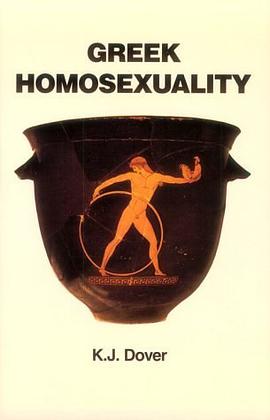
Greek Homosexuality
Greek Homosexuality Douban Goodreads
K. J. Dover publishing house: Harvard University Press 2004 - 5
To what extent and in what ways was homosexuality approved by the ancient Greeks? An eminent classicist examines the evidence--vase paintings, archaic and classical poetry, the dialogues of Plato, speeches in the law courts, the comedies of Aristophanes--and reaches provocative conclusions. A discussion of female homosexuality is included.
Homosexuality and Civilization
Douban
Louis Crompton publishing house: Belknap Press 2003 - 11
How have major civilizations of the last two millennia treated people who were attracted to their own sex? In a narrative tour de force, Louis Crompton chronicles the lives and achievements of homosexual men and women alongside a darker history of persecution, as he compares the Christian West with the cultures of ancient Greece and Rome, Arab Spain, imperial China, and pre-Meiji Japan. </p> Ancient Greek culture celebrated same-sex love in history, literature, and art, making high claims for its moral influence. By contrast, Jewish religious leaders in the sixth century <font size="-1">B.C.E.</font> branded male homosexuality as a capital offense and, later, blamed it for the destruction of the biblical city of Sodom. When these two traditions collided in Christian Rome during the late empire, the tragic repercussions were felt throughout Europe and the New World. </p> Louis Crompton traces Church-inspired mutilation, torture, and burning of "sodomites" in sixth-century Byzantium, medieval France, Renaissance Italy, and in Spain under the Inquisition. But Protestant authorities were equally committed to the execution of homosexuals in the Netherlands, Calvin's Geneva, and Georgian England. The root cause was religious superstition, abetted by political ambition and sheer greed. Yet from this cauldron of fears and desires, homoerotic themes surfaced in the art of the Renaissance masters--Donatello, Leonardo, Michelangelo, Sodoma, Cellini, and Caravaggio--often intertwined with Christian motifs. Homosexuality also flourished in the court intrigues of Henry III of France, Queen Christina of Sweden, James I and William III of England, Queen Anne, and Frederick the Great. </p> Anti-homosexual atrocities committed in the West contrast starkly with the more tolerant traditions of pre-modern China and Japan, as revealed in poetry, fiction, and art and in the lives of emperors, shoguns, Buddhist priests, scholars, and actors. In the samurai tradition of Japan, Crompton makes clear, the celebration of same-sex love rivaled that of ancient Greece. </p> Sweeping in scope, elegantly crafted, and lavishly illustrated, Homosexuality and Civilization is a stunning exploration of a rich and terrible past. </p>
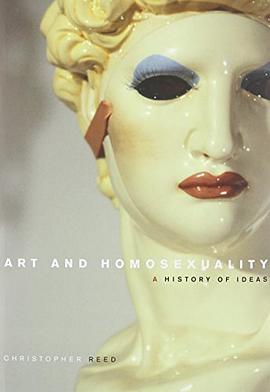
Art and Homosexuality
Douban
Christopher Reed publishing house: Oxford University Press 2011 - 5
Lavishly illustrated with over 175 black-and-white and color images that range from high to popular culture and from Ancient Greece to contemporary America, Christopher Reed's arresting book reveals the deep linkages between art and homosexuality as we understand those terms. This is the first book to fully explore the interdependence between the identity of the artist and the homosexual. It offers a bold, globe-spanning narrative that draws on artwork from all the important periods in the Western tradition, including classical, Renaissance, and contemporary, with special focus on the modern period. It was in the nineteenth century that the identities of the avant-garde artist and the homosexual took shape, and almost as quickly overlapped. The figures involved--Ingres, Courbet, Wilde, Whitman--are among that era's most iconic artists. The development of twentieth-century art--exemplified in the work of figures like Gertrude Stein, Jasper Johns, David Hockney, and David Wojnarowicz--this book argues is simply not understandable apart from the concurrent development of ideas about sexual identity. This highly readable volume challenges the ideas of many prominent art critics and punctures the platitudes surrounding discussions of both art and sexuality. The book discusses what it means to be an insider and outsider, how sexuality came to define one's fundamental humanity, and what people risk (and gain) in rejecting economic and social conformity. Reed shows that many of the core ideas that define modern thought more generally are nearly indecipherable without an understanding of this pairing. The debates that have surrounded artists and homosexuals in effect capture the dramatic history of the evolution of the modern mind.
Read
Dec. 20, 2018
现代主义之前的内容精彩得像过山车。重点则是19世纪“同性恋”一词诞生,反叛社会常规的先锋派,尤其是唯美派把艺术家和艺术结合后,同性恋作为自我标榜的身份,在一百多年里和艺术发展互相缠绕。
两者间的关系因王尔德案被污名化,但在各个先锋派圈子里继续活跃,重新定义性、种族和审美的关系。同性恋身份通过抽象和暗号艺术撩拨“公开的秘密”,经历了二战、战后两种意识形态的打压、抽象表现主义的排挤,5∼60s随着波普艺术和大众视觉文化的兴起获得短暂胜利。7∼80s在主流艺术的冷漠和敌视,女权运动的刺激,艾滋病爆发的悲伤和愤怒中成为强烈的政治呼声,但在保守势力和酷儿的内外压力下,90s同性恋身份呈现出和艺术分离的趋势,走向更加多元和碎片化,但它已永远改变了我们对艺术的理解,也使艺术更能表达基本的人类情感和个人体验
艺术 同性
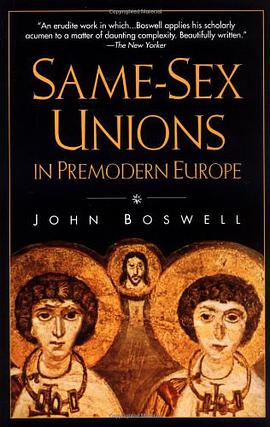
Same-Sex Unions in Premodern Europe
Google Books Douban
John Boswell publishing house: Vintage 1995 - 5
Both highly praised and intensely controversial, this brilliant book produces dramatic evidence that at one time the Catholic and Eastern Orthodox churches not only sanctioned unions between partners of the same sex, but sanctified them--in ceremonies strikingly similar to heterosexual marriage ceremonies.