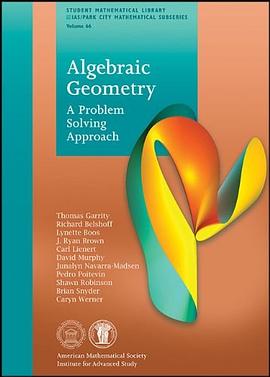
代数几何原理
Douban
格里菲思(Griffiths.P.)
/
哈里斯(Harris.J)
publishing house:
世界图书出版公司
2007
- 5
《代数几何原理》主要内容:A third general principle was that this volume should be stir-contained.In particular any "hard" result that would be utilized should be fullyproved. A difficulty a student often faces in a subject as diverse as algebraic geometry is the profusion of cross-references, and this is one reason for attempting to be self-contained. Similarly, we have attempted to avoid allusions to, or statements without proofs of, related results. This book is in no way meant to be a survey of algebraic geometry, but rather is designed to develop a working facility with specific geometric questions.Our approach to the subject is initially analytic: Chapters 0 and 1 treat the basic techniques and results of complex manifold theory, with some emphasis on results applicable to projective varieties. Beginning in Chapter 2 with the theory of Riemann surfaces and algebraic curves, and continu-ing in Chapters 4 and 6 on algebraic surfaces and the quadric line complex, our treatment becomes increasingly geometric along classicallines. Chapters 3 and 5 continue the analytic approach, progressing to more special topics in complex manifolds.