Brandom
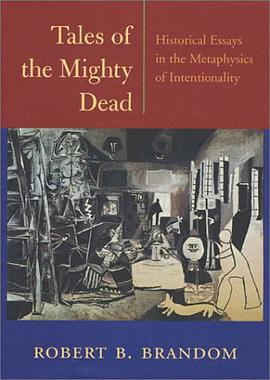
Tales of the Mighty Dead
Douban
Robert B. Brandom publishing house: Harvard University Press 2002 - 11
A work in the history of systematic philosophy that is itself animated by a systematic philosophic aspiration, this book by one of the most prominent American philosophers working today provides an entirely new way of looking at the development of Western philosophy from Descartes to the present. Brandom begins by setting out an historical context and outlining a methodological rationale for his enterprise. Then, in chapters on Spinoza, Leibniz, Hegel, Frege, Heidegger and Sellars, he pursues the most fundamental philosophical issues concerning intentionality, and therefore mindedness itself, revealing an otherwise invisible set of overlapping themes and explanatory strategies. Variously functionalist, inferentialist, holist, normative and social pragmatist in character, the explanations of intentionality offered by these philosophers, taken together, form a distinctive tradition. The fresh perspective afforded by this tradition enriches our understanding of the philosophical topics being addressed, provides a new conceptual vantage point for viewing our philosophical ancestors, and highlights central features of the sort of rationality that consists in discerning a philosophical tradition - and it does so by elaborating a novel, concrete instance of just such an enterprise.
Articulating Reasons
Douban Goodreads
Robert B. Brandom publishing house: Harvard University Press 2001 - 10 other title: Articulating Reasons: An Introduction to Inferentialism
Robert B. Brandom is one of the most original philosophers of our day, whose book Making It Explicit covered and extended a vast range of topics in metaphysics, epistemology, and philosophy of language--the very core of analytic philosophy. This new work provides an approachable introduction to the complex system that Making It Explicit mapped out. A tour of the earlier book's large ideas and relevant details, Articulating Reasons offers an easy entry into two of the main themes of Brandom's work: the idea that the semantic content of a sentence is determined by the norms governing inferences to and from it, and the idea that the distinctive function of logical vocabulary is to let us make our tacit inferential commitments explicit. </p> Brandom's work, making the move from representationalism to inferentialism, constitutes a near-Copernican shift in the philosophy of language--and the most important single development in the field in recent decades. Articulating Reasons puts this accomplishment within reach of nonphilosophers who want to understand the state of the foundations of semantics.
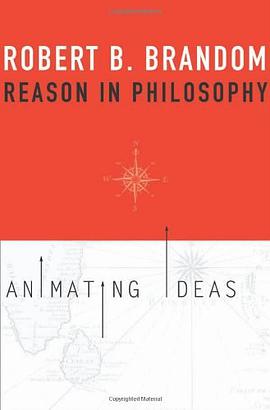
Reason in Philosophy
Douban
Robert B. Brandom publishing house: Belknap Press of Harvard University Press 2009 - 10
Transcendentalism never came to an end in America. It just went underground for a stretch, but is back in full force in Robert Brandom’s new book. Brandom takes up Kant and Hegel and explores their contemporary significance as if little time had expired since intellectuals gathered around Emerson in Concord to discuss reason and idealism, selves, freedom, and community. Brandom’s discussion belongs to a venerable tradition that distinguishes us as rational animals, and philosophy by its concern to understand, articulate, and explain the notion of reason that is thereby cast in that crucial demarcating role. An emphasis on our capacity to reason, rather than merely to represent, has been growing in philosophy over the last thirty years, and Robert Brandom has been at the center of this development. Reason in Philosophy is the first book that gives a succinct overview of his understanding of the role of reason as the structure at once of our minds and our meanings—what constitutes us as free, responsible agents. The job of philosophy is to introduce concepts and develop expressive tools for expanding our self-consciousness as sapients: explicit awareness of our discursive activity of thinking and acting, in the sciences, politics, and the arts. This is a paradigmatic work of contemporary philosophy.
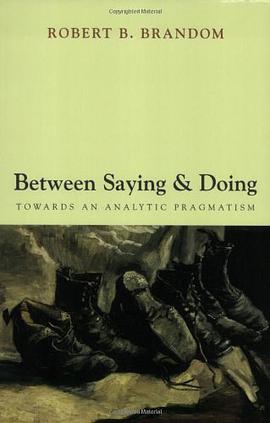
Between Saying and Doing
Douban
Robert B. Brandom publishing house: Oxford University Press, USA 2010 - 6
Between Saying and Doing aims to reconcile pragmatism (in both its classical American and its Wittgensteinian forms) with analytic philosophy. It investigates the relations between the meaning of linguistic expressions and their use. Giving due weight both to what one has to do in order to count as saying various things and to what one needs to say in order to specify those doings, makes it possible to shed new light on the relations between semantics (the theory of the meanings of utterances and the contents of thoughts) and pragmatics (the theory of the functional relations among meaningful or contentful items). Among the vocabularies whose interrelated use and meaning are considered are: logical, indexical, modal, normative, and intentional vocabulary. As the argument proceeds, new ways of thinking about the classic analytic core programs of empiricism, naturalism, and functionalism are offered, as well as novel insights about the ideas of artificial intelligence, the nature of logic, and intentional relations between subjects and objects.